Monday, April 16, 2012

Fabulous Fractions: A TOS Review

My son is in the 6th grade. This year much of his math curriculum has covered fractions. He "survived" fractions, and then the curriculum moved on to decimals, but I could tell he did not completely "get" fractions. When I learned that I could have the opportunity to review Fabulous Fractions, by the AIMS Education Foundation, I jumped on it hoping that more time spent on fractions would help my son.
I've been aware of AIMS materials for twenty years (pre-internet, pre-computer days). My first AIMS materials were Science materials, and I loved them and reused them with every child. Since then, I knew AIMS must still be out there, but I had never gotten ahold of any additional AIMS materials.
I am happy to report that the materials have gotten better and better!

Fabulous Fractions is very nicely put together. The paperback book includes a CD in a plastic pouch inside the back cover, as well as a zip-lock bag of additional transparent, colored plastic manipulatives that I learned called "Fraction Squares" and are used to illustrate multiplication of fractions.
This picture shows the transparent Fraction Squares highlighting pictures in the book:

 I really like having the PDF files on the CD to print from. (Remember, my previous materials I had to take somewhere to photocopy... back in the '90's.) What was a little difficult for me was that the CD files are in Alphabetical Order according to subject title. I would have found it easier if the files were in the same order as the book. This could have been done by having numeric-alpha titles to the files, such as the file name starting with the page number, or something along those lines.


Fabulous Fractions has 185 pages of materials. It is not broken into chapters, but has sections covering the following: Fraction Number Sense; Concepts, Models and Operations; Circle/Sector Models; Linear Models; Slide Ruler Fractions; Area Model; Commentary on Division of Fractions; Coordinate Plane Model; Applications; Playful and Intelligent Practice; and Assessment.

Fabulous Fractions is geared for students grades 3 through 5, but flexible for grades 3-9, and the concepts are presented in order appropriate to introduce each concept in order. In other words, concepts for 3rd graders come first, concepts for 4th graders come next, and concepts for 5th graders come last. I am very pleased that the materials are not marked according to grade level -- that way the materials can be used for remedial work, without the student feeling self-conscious about being given materials age-appropriate for a younger child. (The book does tell the teacher which concepts are appropriate for which age levels.)  You can look at a preview here, to see better pictures than the ones here in this review.

My son's areas of weakness were in the areas of multiplying and dividing fractions, as well as the area of common denominators. Fabulous Fractions teaches multiplying fractions in a really cool way using the Fraction Squares. Here you see 1/2 times 1/3, and the illustration with the Fraction Squares superimposed over each other shows how the answer becomes 1/6 (the square where they intersect, and shows how the original square is now in sixths):

 Fabulous Fractions has a really cool method of discussing common denominators. They call them "CD's" (as in "compact disks", but meaning instead "common denominators"). This section works with circles that are the size of CD's, and explains various types of divisions (I would call them "pies"). Then the book also uses the circle manipulatives to show comparative value of fractions of different denominators. It also uses the circles to demonstrate fraction to decimal conversion!


There is also a section using "slide rule" manipulatives to demonstrate fractions and fraction/decimal comparisons.

There was a section discussing circles as a way to illustrate fractions. It even has a great exercise sorting, dividing, and graphing jelly beans! Our jelly beans from Easter are all gone! I need to go get some more!

I was pleased to find a large section of the book teaching fractions using Tangrams and Pattern Blocks, which is great because I own these manipulatives but did not know how to use them to teach fractions!

There is so much to this curriculum that we still have not gotten to, but I am looking forward to seeing how well it does to help him get a better understanding of fractions, common denominators, multiplying fractions, dividing, and converting to decimals! This looks like a great tool to create understanding and to cement concepts into the brain through real hands-on learning.

Fabulous Fractions book is available from AIMS Education Foundation as a paperback, for $21.95, or as an e-file download for $19.95.

AIMS Education Foundation makes oodles of other materials, with the goal of making math and science fun and understandable for children. I love their materials.

The Nitty Gritty:
Did my son like the program? ...He doesn't like much. He hates math. What can I say...
Is it worth the money? If I were buying this myself, I would not have purchased it. I am too cheap. I have only one child to use it with, and he's at the top end of the age range, and I know how to make my own manipulatives. That said, if I weren't so cheap, my so really did need this extra help, and buying it would have been a good idea.  If I had more children behind him and could use it multiple times, no question it would have been worth the money to me!
Consumable


DISCLAIMER:
I received a paperback copy of Fabulous Fractions  in exchange for my honest review. I was not paid for my review, and this is my personal opinion of the product. I tell my own opinion, whether it is good or bad.

This has been a TOS Homeschool Crew Review.
Photobucket
Go to the TOS Homeschool Review page to see more reviews of Fabulous Fractions and other products by AIMS.

Let me know what you think. Throw me a comment. Thanks!

This review was updated to correct a link and to correct a misspelling of AIMS Education Foundation


Thursday, April 12, 2012

Write with World: A TOS Crew Review

This month I have been blessed to have the opportunity to review a new product by WORLD Magazine.

Their new writing program, Write with World, is written for middle-schoolers, so it was a perfect fit for our home school.

 Write with WORLD is a two year writing program, with separate student and teacher book, one set for each year, and additional on-line resources to correspond to the year you are using. They plan to keep the website updated so that the writing prompts will stay relevant and interesting for the students.

WORLD knew you might wonder why they decided to create a writing curriculum, so the created an answer page: Why Another Writing Curriculum?

From their website, "Write with WORLD is the middle school writing curriculum developed by education and media professionals. Use it to inspire and train your students to become proficient communicators who can meet educational requirements and navigate today's growing new media and conflicting worldviews.

"Write with WORLD exposes students to:
  • reading and critical thinking that develop discernment
  • contemporary subjects and professional guidance to pique interest
  • flexible exercises to build confidence and skill for using today's new media
  • a thoughtful and meaningful Christian worldview"
If you click HERE, you can read an article from WORLD magazine about this new approach to teaching writing.


The Year 1 program is laid out with four Units. Each unit contains four Lessons. Each Lesson contains five Capsules, to be completed one per day. So, theoretically this curriculum could be completed over a 16 week period. 


Looking through the various lessons, it is clear that this curriculum has been laid out in a systematic fashion, with great care to cover the important areas the student needs to develop to become a good writer. There are sections covering the different parts of speech (noun, verb, adjective, adverb, etc.), sentence structure, paragraph structure, topic sentences, etc. It looks very thorough. The time we had been given to use the material before the review was due did not allow us to get very far through the curriculum, but I can't wait to continue on my way through the material with my son.

Now, just to add some balance here, my enthusiasm for this product does not infer that my son likes it. I am the one who likes it. It looks thorough; it looks systematic. It looks like something my son needs. My son doesn't like it. Don't take it personally. My son hates school. My usual disclaimer is, "My son doesn't like it. He hates everything." I've had to adjust that statement because we recently stumbled across something that he liked... But I will save that for another review.


POSITIVES:
First of all, I have long liked WORLD Magazine and God's WORLD News.  I had never been to their website, and now that I have seen it, I am amazed by all it offers. Learning more about Write with WORLD, I really like what I see. This curriculum has a lot of potential.

I personally share for my son the goals WORLD sets out as reasons for creating this writing curriculum.  Again, from their website,  "Write with WORLD aims to produce young writers who love writing, can write effectively, and intelligently share ideas, beliefs, and their worldview. We hope to support a generation of young believers who aspire to use their writing skills in the service of God's Kingdom and explain effectively the reasons for their beliefs."  I love these goals! And I know, from personal experience, that a lot of homeschooling moms really need help to provide this type of education for their children.

So, I love that this program seeks to:
  • teach critical thinking;
  • use advertising the student is familiar with to teach this critical thinking;
  • teach writing skills to a level that prepares the student for college;
  • teach a Biblical worldview;
  • remedial where student skills are lacking.

CRITICISMS:
This is a new curriculum. The copy I received is part of a pilot program, so the comments I make here may enable WORLD to address the areas I am having problems with. So, knowing that these issues may be corrected before you receive these materials as a purchase, this is what I found fault with in these materials:
  • I am not finding a Table of Contents to help me on my way. There is a TOC on-line, but I want it in my book, and I don't want to have to print it out myself.
  • I do not see a section in the Parent/Teacher book for "Getting Started" to tell me things I need to have available for my student, no "Teacher Overview" for the year. Lesson 1 tells the student he/she will need for the lesson his "Writer's Journal", a dictionary, a thesaurus, a timer, a high lighter, magazines with photographs and advertisements. Is the entire curriculum laid out this way? Will I have to pre-read the entire book, lesson by lesson, capsule by capsule, to make sure we are not scrambling at the beginning of writing class to find the required items for each lesson? It would be nicer if there were a schematic in the Teacher book telling what items to have ready for each lesson.
  • In spite of the list on the bullet above, Lesson 1 then instructs the student to write questions down in his "Conversations Writer's Journal (CWJ)". I have no idea what that is. Am I supposed to buy an additional book? Or do we start a plain book and give it a name? I am finding many things unclear. In fact, I think they merged "Conversations:" with the previously mentioned "Writer's Journal", and without transition started calling it the "CWJ".
  • avid, read the definitions, and then "read through the sentence where avid appears again. Choose the meaning that best defines the word..." I really had to search more than necessary to locate the word. It would have been helpful if the sentence had simply said, "Now read again through the paragraph on the previous page where avid appears..." (italics added to show the added words, and I changed where "again" is to make the sentence flow).
  • This is supposed to be a "Year 1" curriculum (as in a "one-year" curriculum), but at quick glance I only see 16 weeks-worth of assignments. I have not yet determined what the assignments are to be for the additional 20 weeks of the school year. [It might be in there. I might just be missing it. I also don't see it in the TOC, and as I mentioned, there is no Teacher Overview for me to look at.] 

A FEW FINAL THINGS:
This program seems best suited to students who already like to write. However, it is probably most needed by students who do not like to write. It is not Charlotte Mason style learning (my normal educational style). I suppose it may lean more towards a Classical style of education, but I'm not sure.

The program does not require a lot of teacher prep, but it is wise to read through the days work in advance, know what is coming, and make sure you are prepared with all the little things that each capsule asks the student to have on hand, such as colored pencils, thesaurus, etc.

This publisher is most certainly Christian in orientation. This program most probably would offend secular educators.

You can see a sample of the student book for Write with World, Year 1, HERE.


Write with WORLD [Ordering Here] Year 1 costs $95, and includes the Parent/Teacher book and the Student book. The Student book can be reused if your student understands to not write in it. My son did not understand that. Before I could explain that to him, he had already written in the book. ::sigh::

WORLD is the same publisher that brings us WORLD Magazine and God's WORLD News, which you can also get to from the above ordering link.


DISCLAIMER:
I received printed copy of  Write with WORLD, Year 1, in exchange for my honest review. All opinions are my own. I receive free products in exchange for a review. The review is honest. If I like it, I say so; if I don't like it, I say so.

This has been a TOS Homeschool Crew Review.
Photobucket

To see more reviews of this product, click on the above Old Schoolhouse Homeschool Crew banner.

Let me know what you think. Throw me a comment. Thanks!

Friday, March 30, 2012

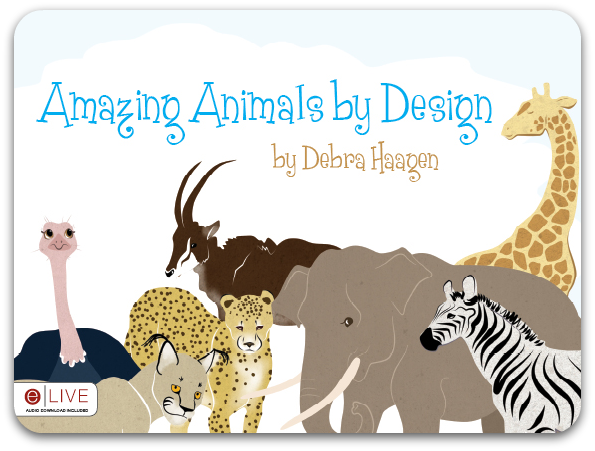
Amazing Animals by Design: A Review

Why do elephants have trunks? Why do giraffes have long necks and such long tongues? Why aren't zebras camouflaged?

There are many questions children ask when they visit the zoo. In the 1990s I had two little girls, and we used to go visit the Denver Zoo. We especially liked to go visit the white giraffe, who seemed to be so unique to us. We were also always amazed to watch the giraffes, with their long necks and tongues. Their yard was bare, hard packed dirt, with a few tall trees with fenced trunks. We would watch them streeeeeetch their necks and snaaaake their tongues up into and around the few scant branches of the trees. They would wrap that tongue around the branch and strip off those leaves and eat them. It was amazing. And we were told that giraffes evolved to be able to find food that had not been eaten by the other animals that were lower to the ground. I cringed.
I wish now that I had then had Amazing Animals by Design, a new book written by Debra Haagen, another member of the TOS Homeschool Crew. In her home schooling of her children, Ms. Haagen found that there were books written to discuss animals as uniquely designed for where they live, how they eat, etc., but that these books were all targeting older students. There were no such books available for the younger students, and Ms. Haagen set out to change that.

I initially thought I would be able to review this book with a six year old boy of a friend of mine, but that arrangement did not work out, so I am only able to give you my own impressions of the book and not the impressions of a child. What I found, in reading the book, is that it would have fit right in with my Charlotte Mason teaching style. Each animal mentioned in the book, with just a few snippets of information about the animal, opens the opportunity for the children to ask more questions and learn more information about animals they are interested in.


"Just how long is a giraffe's neck?"

"How many stripes does a zebra have?"

"How fast can a cheetah run?"

"What is a caracal?"

"Do ostriches really stick their heads in the sand?"

"Barbary sheep? That looks like an antelope!"

All of these questions give the opportunity to pursue more information. Some children may look for the answers on their own; others may ask mom or dad for help. But questions lead to learning, and in my opinion Amazing Animals by Design leads to questions, which is a good thing.

I had never heard of a caracal, so I looked it up. I particularly wondered if they were supposed to have a bobbed tail, like a bobcat. (They are not.)  I thought Barbary sheep looked different than the illustration, so I looked it up. (I still think the horns in the illustration don't quite capture reality, but I shouldn't complain -- I'm not an illustrator, so It's not like I could do a better job...)

Amazing Animals by Design is a 24-page book geared toward K-3rd graders. Younger children might also enjoy it as a read aloud. Older children might be able to read it aloud to your younger readers or pre-readers.  While this is a good book to just generally have in your child's picture-book reading basket, it is also an ideal book to use as part of a zoo unit study, or to be read in preparation for a trip to a zoo. Then you can make a scavenger hunt to see if all the animals in the book are found in your zoo, and list other fun animals your zoo has that are not in the book.

Amazing Animals is currently available as a digital download for $7.99 (as a PDF e-book). You can also purchase a paper version for $8.99 to be sent to you after the book's release date, April 1, 2012 (at which time it will also be available through other retailers).

DISCLAIMER:
I received a digital copy of Amazing Animals by Design  in exchange for my honest review.

This has been a TOS Homeschool Crew Review.
Photobucket
To see more reviews of this product, go to the TOS Homeschool Review page for Amazing Animals by Design.

Let me know what you think. Throw me a comment. Thanks! 

Thursday, March 29, 2012

A Doggy Tail

It is March. The weather is unbelievable!

Last week, mid-March, the grass was already too long.  B and S got lost in the "jungle". A search party had to be sent out. This is apparently where they had taken refuge when S had decided all was lost:


Well, the pups still needed to go out, so I rounded them up and headed them out. Most of them were unwilling to go far from the house. I mowed a lane of grass, and they stayed there, all except P, who was fearless!


Well, it needed mowing, plain and simple. So, I mowed it.


When I was done six very happy puppies cavorted in new territory, where they had previously been afraid to go.

And then a week went by, and it rained on three or four days of that seven day week, and the lawn again needs to be mown!

For those who are wondering at this random blog entry, I did it for a friend who was missing her puppies so that she could see how they are doing.  Fear not. I will make all effort to soon get back to my previously scheduled entries of nature study, artist study and composer study!

Monday, March 26, 2012

Action Alert: A TOS Crew Review

This past month I was given the opportunity to try out and review a product called Action Alert.
The goal of Action Alert is to protect kids from online dangers (as shown above). They are so committed to this goal that they have created a FREE program for you to use on your computer that will assist you in this effort. They have also created a PREMIUM program that you can select, if you prefer, that provides even more options. Let me tell you more.

The Action Alert program works (with your individualized input) to:
  •  create a kid-safe PC, with web site blocking and filtering;
  • control computer use, with comprehensive time controls; and
  • alert you if there is any suspicious activity, and also allowing you to review activity.
Action Alert will send alerts to your cell phone OR your computer. I opted to have alerts sent to my computer. I think, at this point, that cell phone alerts might be a better option because my computer does not notify me every time a new email arrives in my inbox, so I didn't get the notifications quickly. And it was difficult, after the fact, to determine how much lag time there had been between my son's activity and the alert being received. 
Action alert provides for your computer:
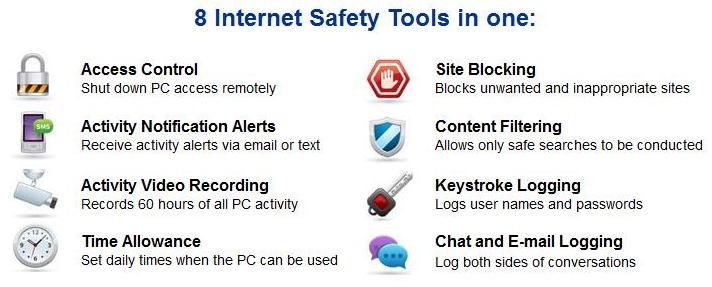
Action Alert provides for your computer eight Internet safety tools in one:
  • Access control (shut down the PC remotely from your own computer or your cell phone);
  • Activity notification alerts to your email or texts to your cell phone;
  • Video recording of 60 hours of PC activity for you to review to understand exactly what your child did/where he/she went;
  • Time Allowance (set up in advance, for example, one hour usage a day, or no usage between 9 p.m. and 8 a.m.);
  • Site Blocking (for my family, I completely blocked "YouTube", because of previous experiences);
  • Content Filtering, allowing only "safe search"es to be conducted (there is a key-word database that the program will not allow the user to attempt to search on);
  • Keystroke logging (logs user names and passwords, so you can more easily monitor your child's actions on line);
  • Chat and E-mail Logging, logging both sides of the conversation.
Boy, my life would have been so much different if I had had this program when my 25-year-old was in my home! She still firmly holds that a teenager should have "privacy" rights in the parents home, but a parent has to do what they can to protect their children as they grope their way through the murky teen years to adulthood.

The differences between the free protection and the maximum protection are... more protection. The website lays it out to make it appear that you really get almost all of the features from the free program, and I have the maximum program, and it is difficult for me to sort out what is not provided on the free program. But here are the main things it appears you get on the maximum program that don't come with the free:
  • You can set the program up for multiple users (each with different settings) on the Maximum Protection program;
  • The Maximum Protection program is more fully customizable. I assume this means there are certain pre-settings in the free program that are more customizable on the Maximum program.
  • The Maximum Protection gives full social network monitoring. Since my son does not yet have permission to participate in social network websites, I did not try this out and cannot tell you exactly what you would not get with the free program that you would get with the Maximum program.
No matter how I look at it,  having some sort of Internet safety tool on your child's computer is essential. We had some trouble a while back with my son going places he should not have gone. We researched out various programs and settled on one which we put on one of our computers, but I have not been satisfied with it. When I showed my husband only just part of Action Alert Maximum Protection provides, he was highly impressed. While my son knew the program was on the computer, he tested it various times, once by doing a You Tube search on a forbidden word (and then we blocked You Tube), once by going on the computer when he was supposed to be asleep (and then I adjusted the allowed times), and I can't remember the other one(s).

So, each time my son violated limits we had already set previously, we received a notification that he had done so. This was so immensely helpful, because previously we could have our suspicions, but without knowing for sure we could not bring consequences or changes. Now we knew for sure, and there were immediate consequences.

Action Alert has received some awards that you may appreciate being made aware of:
Child Safety Network Seal:
iParenting Award


 The were also featured on the Today Show!
I am so glad I have this program on his computer, and I will continue to use it. But here is where I let you know some difficulties we had with the program.

MY GRIPES:
  • There does seem to be some lag time in the notification system. I received an email alert (which I read remotely on my smart phone) that my son had attempted to go to an inappropriate site). Just for fun, I decided to use the option to immediately disconnect him from the Internet, since he wasn't supposed to be on the Internet when I wasn't home anyway. Turned out he had gotten off of the computer hours before I pushed the button. I have no way of knowing how long the email  had been in my inbox before I got it, but there had to have been some lag time. I think my son had gotten off the Internet before I even left the house...
MY PRAISES:
  •  I LOVE the time limit feature, as well as the time of day feature. When my son's time is up, it's up! There is no arguing. If he has been doing school work, I can give him an "Override", but it is not a complete override (like the other program we tried, which then gave him access to EVERYTHING with no limits! ::sheesh!::) -- after another hour, he's kicked off again.
  • I LOVE the monitoring. Once my son realized I could really track his activity, he really adjusted and shaped up his behavior, going only where he had agreed to go. 
  • I LOVE the web-site blocking. It is well done. It has done what I asked of it the way I wanted it to. 
  • Their tech support was very helpful when they were open. I learned it was not wise to have problems ...after hours... ::sigh::
MY RECOMMENDATIONS:
  •  I highly recommend this program be used when you have a back-up computer. It can be very dicey when you get locked out of your own computer and can't find a way to get back in, especially if it happens during hours when tech support is not available.
  • Set the computer up with multiple users, with an "Administrator" as one option, with the Administrator having less restrictions.
Action Alert Free Protection is ... Free!
Action Alert Maximum Protection costs $29.99 per year. I will probably renew when I need to, because I like this program!

DISCLAIMER:
I received one year of Maximum Protection Action Alert in exchange for my honest review.

This has been a TOS Homeschool Crew Review.


Photobucket
To see more reviews of this product, go to the TOS Homeschool Review page for Action Alert.

I do highly recommend this product, but it is intensive and needs you to take time to understand it and set it up carefully. I saw some folks seemed to have problems with their computer with this product. I did not experience this. Maybe it was an available space issue. My son's computer does not have much on it.

Let me know what you think. Throw me a comment. Thanks!

Monday, March 19, 2012

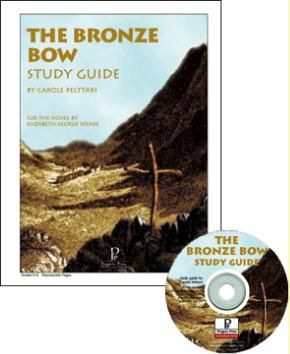
Progeny Press: The Bronze Bow (A Review)

Progeny Press is a company that has been in business many years, providing materials that help parents and students get the most out of their literature.
I remember using Progeny Press guides for my older daughters for books they studied, Les Mis, Old Yeller, ...actually so many I can't remember them all. (They were in a co-op, so it's a little hard to remember which titles they used these guides with...") Progeny Press guides give the teacher permission to reproduce the guide in the classroom for use with the students. That's how my kids had access to these guides previously without my being very familiar with them.

Recently I was offered the opportunity to review a Progeny Press Literature Guide with my son, my present homeschooler. Knowing the quality of the company and their guides, I jumped at the opportunity. I was offered a selection of titles to choose from, and I asked to review The Bronze Bow.

I was pleasantly surprised to learn that the Progeny Press guides have changed. First of all, they are now available in digital, which is the type of guide I received. (Okay, lately for me this is a negative, because I go through so much ink on my printer any more... You have no idea...) My guide was sent to me via a link. The product is also available via CD and print versions. The book itself (The Bronze Bow, for example) does not come with the product. . You can view their complete product line in their Progeny Press catalog.   Progeny Press study guides are available for Lower Elementary, Upper Elementary, Middle School and High School. Study guides cost from $10.99 to $27.99

The pleasant part of the surprise, though, was not that the product I received was digital (see above note), but that the digital guide for the student can be either printed out OR used interactively! If the student uses the Interactive format, the teacher can then read and grade the answers on the computer, even adding comments when grading as well! However, I need to back up so I don't leave anything out here...

The digital package I received for my review included the following:
  • The Bronze Bow "Read Me" file for the product (for the teacher);
  • The Bronze Bow Interactive Guide (for the student(s)) [You make a file copy for your student to use, keeping the "original" clean so that you can use it for as many students as you have.]; and
  • The Bronze Bow Interactive Guide Answer Key (for the teacher, obviously).
The "Read Me" file gives the teacher complete information on how to use the guide successfully, which software to use, what the copyright allowances/restrictions are, how to use the interactive materials, cautions to back up files, etc. In my opinion, the first time using one of these guides it is helpful if the teacher and student each have a computer to use, so that the teacher can have the "Read Me" file open to walk the student through the use of the Interactive Guide until he/she becomes familiar with how it works (unless you are printing out the guide, preferably in color, which would make the 2nd computer unnecessary).

The to the Interactive Guide best says the reasons for using Progeny Press Literature Guides: "Progeny Press study guides are designed to help students better understand and enjoy literature by getting them to notice and understand how authors craft their stories and to show them how to think through the themes and ideas introduced in the stories."  When I think, over the years, of the stories we have read without analyzing, it's enough to make me feel entirely inadequate for the task of homeschooling! However, I need to remind myself that we don't need to analyze everything that we read, but that it is a skill and practice that we need to introduce to our students to prepare them for college and for life.

The guide says that most Middle and High School guides take from eight to ten weeks to complete. We didn't have that much time, and we didn't complete the task, but I am able to review with what we did do.  The guides also contain an "Overview" at the end which can be used as a final test on the material, which is excellent (in my opinion).

The plan for using the guide begins with instructions to have the student read the book the first week. Well, this is where we already broke down on the plan. My son's entire school career, thus far, has been a different approach than this. My son, while a voracious reader (of what he chooses to read), has never read a book that I chose for him to read in just one week. So that didn't happen, even though I got the book in audio format from the library. ::sigh:: (I think it would have worked for me if it had been a book I had already been planning to do, instead of a book I was adding onto our already challenging school work...)

The Guide contains questions of multiple choice, but also many opportunities of answering questions in essay format, which my son does need to be instructed in, so I can see that, as a first guide this one was more than he was ready for at this time, but as a teaching and learning tool it is a perfect launching point to get our "Writing" program onto the right track for his grade level.

The guide gives Internet references, and the parent should use due diligence to supervise the student if the student wants to follow up on those references, not because Progeny Press put anything bad into their references, but because with the nature of the changing Internet, something could have happened to links that were once good links.

The Interactive Guide gives a nice synopsis of the content story, background information about the historical setting behind the story, as well as a brief biography of the author. It also gives some very nice "Pre-Reading Activities" to supplement the reading, including suggested map work, some Bible reading suggestions, and some vocabulary work. The guide contains some fun stuff, such as a crossword puzzle. The guide gives some work on characterization, thinking questions to be answered in short sentences (and some in essay format), suggestions for creative writing, written report, persuasive speech, discussion about conflict in writing, more vocabulary, discussion about protagonists... There is oh so much good stuff in here! And I like it! I need to do more of this!

Progeny Press actually carries over 100 titles, and at this point I am giving serious consideration to looking through these titles to find another title (for a book we are currently already reading) so that I can really jump in with both feet. I really need to do this type of work more often in our literature studies. We didn't finish our work on The Bronze Bow before this review was due, and at this point I will just save this guide and reintroduce it at a later time when we are actually studying that time era. (We are currently studying the beginning of the 1800's, so doing The Bronze Bow at this time was difficult for us. My son saw it as "add on" work, not part of his normal assignments.)


So I really like this company and their products. I know writing is a weak subject in my home school, and these products can really help me work on that weak area more and strengthen it. I am also weak in literary analysis, and these guides will help me there as well.

So, how did mom like the product? I give it a 10 out of 10.

How did junior like the product? Eh... he hated it. "Give it to Mikey. He won't eat it. He hates everything!"

~~~~~~~~~~~~~~~~~~~~~~~~~~~~~~~~~~~~~~~~~~~~~~~~~~~~~~~~~~~~~~~~~~~~~~~~~~~`
Disclaimers:
I received a free digital download of this product for free in exchange for my honest review.

This has been a TOS Homeschool Crew Review.

Photobucket 
To see more reviews of this product, go to the TOS Crew Review page.Throw me a bone! Leave me a comment! I love comments!

Friday, March 16, 2012

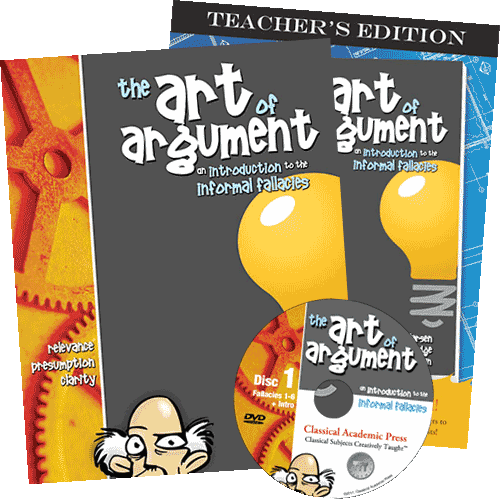
Classical Academic Press: The Art of Argument (A Review)

This month, as a part of The Old Schoolhouse Homeschool Crew, I had the opportunity to review a product by Classical Academic Press called The Art of Argument. 
I had long wanted to have an opportunity to dabble in argumentation and debate. Does that surprise you? Well, long ago I realized that there are certain aspects to argumentation that, if you can learn them (and learn how to observe them and use them well), it can make it possible to have disagreement in a more cerebral, less emotional way.

I'm not sure if I am making myself clear. But, many years ago an attorney friend of mine, who taught debate, helped me to get the tiniest glimpse of the concept of a fallacy, and catching a person in a fallacy. And this program goes into the concept of fallacy (and 28 forms of informal fallacy) in great detail.

I received the following items free from Classical Academic Press, in exchange for my honest review:

This program contains three units, split into six chapters, covering 28 fallacies, and is designed to be spread out over one full school year.

Now, I know the DVD set is a little expensive, but the DVD is so worth it! I am totally loving the age of technology we are coming into with DVD sets. They are making my homeschool so much more successful (and easier!)!

This curriculum is geared towards Junior High students, which is perfect because as they hit that age-range (seems to start at about age 13), their brains are changing and they start to become very argumentative. It can seem they are becoming disrespectful, but that is not (necessarily) their intent. They are just at a changing place in their development where they are trying to figure things out. Equipping them with the ability to argue well enables them to approach situations much differently, and assists in diffusing many emotionally-charged situations.

Studying this material also enables the parents to see where their own arguments have fallacies. For example, I remember one recent situation where, even though I knew it was a fallacy, I had to ask my child to go clean up/change clothes, whatever the situation was. We were trying to accomplish something serious (I think it was a heart-to-heart talk), and I had to tell my child that I was really having difficulty taking him seriously when he looked so ridiculous; it was distracting. (I think maybe he had written on his face with marker or something...) So, the fallacy that ran through my mind was an example I had heard in the past of a type of setting where an attorney is trying to discredit a witness because of something unrelated that the witness had done in the past.

I think the fallacy I was thinking of might fall into the category of "Ad Hominem Circumstantial". But while I was looking it up to figure out what type of fallacy it might be, I saw another fallacy that I can illustrate even better. When I grew up, in the public school system teachers would often get siblings from the same family as they all worked their way up through the grade school. I remember distinctly situations where a teacher might say something like, "Oh! You're Kenny Smith's brother! I should have known I could expect this type of behavior from you..." This is an example of "Ad Hominem Genetic" fallacy, the student is guilty because of source of origin (from the same Smith family, therefore they're all bad).

The books clearly lay out different categories of fallacy, and specific fallacies within each category. For instance, the above "Ad Hominem" category refers to arguments against the source (discrediting the source as a way to win the argument). Another fallacy category is a category of appeal to emotions as a way to win the argument. A last category of fallacy, and one of my favorites, is the category of red herrings, which refers to presenting "proofs" to support the argument which are not emotion-related, but are nevertheless irrelevant to the situation.

The Art of Argument Teacher's Edition now contains the complete text of the student book, with the answers filled in on all the question spots. Having the student book contained in the teacher's book is hugely helpful! The TE also contains all the tests (to photocopy), as well as the test answer key. (This is so much nicer than some curricula where you must purchase the student textbook; the student activity book; answer key to the student activity book; test/quiz book; answer key to the student test/quiz book; and possibly an additional teacher book that gives things like recommended daily lesson plans, lecture notes, etc. All in one place. Nice.

So, the nitty gritty. On a grading scale of 1-10 (10 is the best):
  • Affordable? 10
  • Relevant:  10
  • My student liked: (N/A - he's 6th grade. I can't wait to use this with him next year!)
  • Age range of the product: Junior High, but older and younger could benefit as well. It's just that that Jr. High age is perfect for introducing the topic of Logic to. High school is then a good time to get into more formal debate.
  • Educational style: Classical
  • Necessary teacher prep: It is wise to read through each lesson in advance, or while the student reads through. If doing the DVDs, the parent can let the student do the material independently with the DVDs (if the student is honest and will do what he says he will do -- I prefer to do everything with my "less trustworthy" student at this time)
  • Consumable or reuseable: TE is reuseable; student book is consumable
  • Secular/religious: I detect no "bent" one way or the other. The book, very reasonably, deals with real-world-style advertising issues, but nothing that I saw was objectionable.
  • What did I like or dislike: I like everything about this program. I disliked that they did not give me the entire 6-DVD set, but, hey...
  • How could it be improved: I did not see anywhere in the book material a place where there is guidance on how to implement the program (daily/weekly lesson plan strategy). I saw one comment on the website that one Facebook fan did Unit 1 one year and will do Unit 2 the second year, so maybe they just want the parent to decide the pace, but I still would have preferred an example of a plan...
  • To whom would I recommend the program: to everyone with up-and-coming middle schoolers, and most especially boys! (My girls would have done well also, but I find my son more argumentative, ...or maybe I am just forgetting. It's been 10 years since my daughter was this age...)
So I highly recommend you consider looking into this product. It is going to be part of my school plan this coming year. I am home schooling using the "Charlotte Mason" approach, but implementing this material does not, in my opinion, in any way conflict with that approach. I DO want my homeschooling to implement a program of Argumentation and Debate, and this program looks like a winner in my home!

This has been a TOS Homeschool Crew Review.

Photobucket 
To see more reviews of this product, go to the TOS Crew Review page.Throw me a bone! Leave me a comment! I love comments!

Monday, March 12, 2012

Life Sciences Task Cards (Creek Edge Press)

Recently I learned of a new company that has created an interesting new product. The company is Creek Edge Press, and the product is Task Cards for various academic subjects.

The concept of task cards apparently originates from the Montessori Approach to schooling, where the goal is to encourage the students to own their education by making their own choices as to what they will study, and making choices as to which aspects they want to focus on and how they will pursue information, etc. The approach is new to me, but is very compatible with the way that we homeschool. The creator, Amy Kate Hillsman, developed these cards to use in her own homeschool. As friends learned of them they began asking for sets, and it became clear that there was potential to create a small business for her family, and Creek Edge Press was born. 
You can learn more about Creek Edge Press, the card system and the author at THIS LINK, and there are actually more articles here that you can read to learn more. You can also go here to see snapshot photos of many of the Task Cards as samples.

I was delighted to be offered the opportunity to review this company's products. I received a set of Task Cards and an accompanying introduction booklet with my package from this company. I received one set of cards for free in exchange for my honest review (I received no other compensation). I was happy that we were offered a selection to choose from, and since we have been studying Life Sciences this year I chose that set.
Now, looking at these cards, first reaction on first glance was, "I could have done this...!" But the point was, I didn't. And Ms. Hillsman did. And they are good!

These task cards even get my creative juices flowing. The particular topic my son selected to learn more about was spiders. Selecting card #9, Spiders, Mites, Scorpions, he dug in to learn more. The first possible choice was to do some encyclopedia research, so for the first time (with this son) we pulled out the encyclopedia, and he read the selection on spiders.

Other tasks choices for his further interest including reading books about spiders, learning how to classify spiders, sketch and label the parts of a spider, name two kinds of poisonous spiders, find a web to observe and sketch, and research and map places where poisonous spiders live.  Now, just having those ideas my brain began to come up with additional ideas, like do some research on the common orb spider (one we often see around our home), or get a field guide and (attempt to) identify some of the spiders we commonly see. Then my mind began brainstorming ways other topics could be tackled using similar research ideas. (My son has an interest in snakes. "Learn names of two poisonous snakes." "Learn poisonous snakes that live in our country, and make a map showing their regions.")

These products look adaptable to all age levels. Younger kids can use them with parental help (parent reads; parent writes down what child wants written down  for pre-readers; requirement of more detail for high schoolers).


So, I really, really like this product.  In addition to the Life Sciences Task Cards, Creek Edge Press also has the following task card choices: You can see more samples here: GALLERY

This has been a TOS Homeschool Crew Review.

Photobucket 
To see more reviews of this product, go to the TOS Crew Review page.Throw me a bone! Leave me a comment! I love comments!

3