Showing posts with label TOS Crew. Show all posts

Thursday, October 4, 2018

Books of the Bible At-a-Glance - A TOS Homeschool Crew Review


At the end of the summer I learned I would have the opportunity to review an amazing product by a company called Teach Sunday School.
Teach Sunday School
The product I received is Books of the Bible At-a-Glance.

Books of the Bible at a Glance

I received this as a digital product. It includes 74 pages, which includes one page for each of the 66 books of the bible, with a cover page and introductory pages at the beginning.

When I received Bible At-a-Glance, my personal studies were in the book of John. Thinking it through, "Matthew", "Mark", "Luke", "John", I decided to print the first four books of the New Testament using double-sided print. I also needed a look at 3 John, so I printed that as well. I tried using color print, but my printer wasn't up to snuff, so I switched to black and white. I figured I would 3-hole punch the paper and start a 3-ring binder for my Books of the Bible At-A-Glance.

So that you can see what the printouts should look like, here is a snapshot of the John page from the PDF:


See how vibrant the colors should be? My printer is disappointing me greatly.

So now that you see the page for John, let me zoom in and highlight it for you section by section (larger, easier to see).

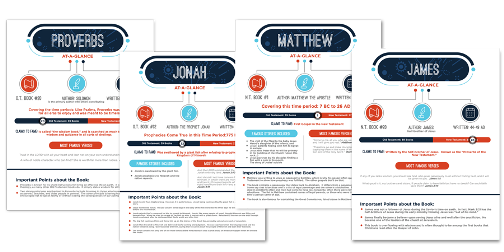
At the top of each page, the name of the Bible book is at the top. Next you see what number book it is in the Old or New Testament,


who the author is thought to be, when it is thought to have been written, and the time period it covers. John is thought to have been written 80-90 AD, but it is a history of the period from approximately 7 to 26 AD.


The next line reminds you that there are 39 Old Testament books and 27 New Testament books, with a numeral 4 reminding you that John is book 4 in the New Testament. Each book has a "Claims to Fame" section. There is a reminder of famous stories included in the book, as well as the books "most famous verses".


The bottom of each page lists important points about the Bible book.

After working with John and 3 John, I worked in Philippians. I was getting into a groove. Then I was reading in Psalms, and I had forgotten Bible At-a-Glance was the entire Bible! I got excited all over again.
Not liking how my printer was working I decided to put my document PDF onto a thumb drive and head to Kinko's to get an estimate on printing and binding the product as a spiral.


Boy was I surprised at the price they wanted to charge. I scrapped the idea and headed home. I discussed it with my hubby. I'll just print out pages as I need them and go with my initial plan of having a printout in a 3-ring notebook that I build as I go along.

I can also just work from the PDF document, but I'm a real paper-in-hand (book-in-hand) kind of girl, so I like to have a print out. Eventually I will probably be highlighting sections and taking notes like I do in my Bible. That's hard to do on a PDF.
I am not a major theologian. I did not attend seminary. When I read my Bible and am curious about who wrote what or when it was written, I am not majorly concerned about exact accuracy, so I was not looking at that type of question as I was reviewing my Bible At-a-Glance, so I cannot speak to accuracy. All I can say is that for a lay-reader of the Bible this is a wonderful product. I found it incredibly helpful. I love it.

So consider adding this product to your collection of personal Bible study tools. Or, before you do that, maybe you want to read a few more reviews and see what other reviewers thought. Maybe someone else was/is "more objective" than I am or saw different perspectives that they brought out that might interest you. To read additional reviews of this product, click on the button below.
Books of the Bible At-a-Glance { Teach Sunday School Reviews}

Wednesday, August 22, 2018

Homeschool High School - Fitting it All In

I've come a long way since my first student was in high school. First time through high school, I was just trying to figure out how to complete the "required" high school courses. (The state of Maryland has required courses for public school students. I wanted to follow these guidelines in case my students wanted to go to college.)


My oldest graduated in 2004. My student was part of a co-op for History and Literature. I got her into outside classes (usually that means I paid someone else to teach her) for Algebra I, Geometry, Biology, Anatomy, Chemistry, Latin and flute. I created a chart of the requirements and turned it into a transcript, filling information in as she completed courses. She started some of her high school work in 7th and 8th grade, which gave her extra time in later grades to work part time and pursue many outside interests. 

She was passionate about violin, and joined the local Montgomery County Symphony Orchestra, which met once a week in the evening.


Getting her violin restrung, she was offered a part-time job at the violin shop and developed skills as a luthier. 

She was very active in 4-H, and loved baking, candy-making, and did a significant amount of sewing, crochet, and knitting.


Eventually she was crowned 4-H Queen of the Montgomery County Fair.

How did we do it? That is the question.

In 8th grade #1 began high school coursework through a co-op (Tapestry of Grace) in English Composition and Literature, Latin and History. #2 had co-op classes as well, which I helped run. She also took flute lessons. There was no child #3, and I announced my pregnancy in May.

In 9th grade, #1 continued in co-op, but I think we gave up the co-op for the younger group. #1 was also taking Latin at the same location, and taking Biology and flute lessons at locations near home. We may have been working on Algebra 1 at home, or she may have taken it at someone's home, I can;t remember.  #3 was born in November, days after we had a unit celebration of a Medieval Feast.
For awhile after the birth friends helped me out transporting #1 to classes. I did my best keeping #2 on track at home. Eventually I was able to get back to actively transporting her to activities again.

In 10th grade #1 continued on in the co-op, taking Latin 2, Anatomy, and flute as outside classes. Can you see a theme here? For most of high school I was a taxi. Since the classes she took were co-op, that meant I taught a class about every six weeks in rotation with other parents. She began working at the violin shop this year.

In 11th grade #1 took her fourth co-op year of high school level English Composition/Literature, her fourth year of high school level History/Government, and continued flute. She took Driver's Education and got her license. She took Chemistry outside the home as well.

In 12th grade #1 was done with most of her classes. She spent more time reading, playing violin, and working at the violin shop. It was 15 years ago, so I may have gotten some of the order wrong - she may have taken one of the earlier-mentioned math or science courses this year. She graduated with a group of home schoolers from our church's home school group.

As I think back on those years, I have glossed over the struggles we experienced, the tears, the stress, etc. I don't mean to white-wash things. It was a very difficult time for our family, and the stress on our first-born was huge, and she suffered as a result of it. We did the best we could. For us, getting it all done, fitting it all in involved a lot of outside classes. I know that doesn't work for everyone.

What is working in your homeschool high school?

Other members of the Old Schoolhouse Homeschool Crew are also blogging the 5 Days of Homeschool Encouragement. To read more posts, please click the button below.
http://schoolhousereviewcrew.com/work-it-in-wednesday-5-days-of-homeschool-encouragement/

Tuesday, August 21, 2018

Can we talk about Field Trips?


Hands-on learning is the very best kind of learning, and field trips can be a very good idea to support hands-on learning.

As I consider beginning a discussion of field trips, issues that come to mind are:
  • financial considerations;
  • location;
  • age and mobility/obedience of the kids
Financial considerations
Field trips can cost money, so if there is no money to spend you need to understand that field trips do not need to cost money! Or they might cost as little as the gas to drive your car. Ways to make a field trip free include:
  • packing a lunch;
  • everyone taking a water bottle;
  • taking a gallon of extra water (or more) if appropriate and necessary.
Or none of the above if it is a short field trip! Examples of free field trips I have taken my children on include:
  • visiting a local nature center;
  • visiting a local farm to see baby goats;
  • visiting another neighbor to see their chickens;
  • taking a nature walk at a local park;
  • visiting the local air port to watch planes land and take off;
  • visiting the fire station when they hold an open house;
  • visiting free museums and free zoo in the Washington, DC area (where I live);
  • visiting local courtroom and sitting through a trial;
  • visiting city council meeting;
  • visiting train station and watching for trains.
 Moderate expense field trips would include things like:
  • take the kids ice skating;
  • go to a movie matinee;
  • go bowling;
  • take a ride on the local subway (just to ride the train!);
  • take trips to historical sites that have small fee
 More expensive trips might be:
  • Go to a glass blowing factory tour; make a glass ornament;
  • visit museums that charge a fee, like a Children's Museum, Building Museum, Aquarium or Zoo;
  • Go to a ceramics shop where you can make a ceramic item;
  • Go on a "date" to a local coffee shop or restaurant
We've gone on many field trips through the years. Sometimes the parent (me) can get exasperated when the focus of the field trip (light house and marine museum) are not what the child is interested in (wading in local flooding).

In the early years, I was always looking for learning opportunities. Visiting Nana and Pop Pop in Florida, we visited Ft. Christmas. I was intrigued. My girls were bored to tears.


 We visited a Cabbage Patch Doll Factory.
 Two of my kids went to Space Camp
But some of our best field trips, I did not attend. My girls participated in a co-op, and the group visited Harper's Ferry, West Virginia (which I did attend)

New York City

and even Europe. Talk about expensive! The kidlet had to work to pay for that one!

But some of the best field trips were just plain free. When your kid just needs a break, sometimes it is just more productive to get out of the house and experience nature.

So look at your year. Maybe plan one Friday a month to set aside as a field trip day. Adjust this idea as you need to for your budget and for what is available in your area, but consider a schedule like this:
  • September: zoo
  • October: orchard/farm to pick apples and/or pumpkins
  • November: Visit an area of early American interest (thinking of Thanksgiving). I might go to my local Sandy Spring Museum, Sandy Spring, MD
  • December: attend a showing of The Nutcracker, or visit a living nativity or some special activity that has been scheduled for Christmas;
  • January: Go ice skating;
  • February: go to the local natural history museum or building museum;
  • March: go on a nature walk and look for signs of spring;
  • April: visit a location where you can observe cherry blossoms
  • May: Go to nature center and take a hike. Observe three new bird species and learn about them.
  • June: Go to a local park with a lake. Consider renting a canoe or paying for a ride on a pontoon boat.
  • July: pick strawberries (June?) or blueberries at local farm. 
  • August: go to county fair
Other members of the Old Schoolhouse Homeschool Review Crew are also participating in the 5-Days of Homeschool Encouragement blog hop. To read more posts, please click on the link below.
http://schoolhousereviewcrew.com/take-a-look-tuesday-5-days-of-homeschool-encouragement/

Monday, August 20, 2018

A Letter to the Struggling Homeschool Mom

Dear Home School Mom,

Get a cup of coffee and settle in for a Mom to Mom chat.


Ready? 

So I hear you are feeling overwhelmed. It is almost time for your school year to start, and you aren't ready. You have children you need to teach, but you have a baby in the house. 


You feel like you should already have a 36-week-lesson plan figured out for all your subjects, and right now you are just wondering if there are enough clean clothes for everyone and what you will serve for dinner tonight.

Well, let's start by breaking this down piece by piece.
  • Laundry: Okay, so someone might have to wear something that's not exactly clean today. That is the beauty of home schooling. You aren't going anywhere (school), and this isn't a beauty contest. If Child #1 needs to loan a shirt to Child #2, or Child #3 needs to wear yesterday's outfit, life will go on. Get the kids each to grab an armful of dirty laundry and meet you at the washing machine. Put the baby in a bouncer seat on top of the dryer and start a load of darks in cold water. Now the only important thing you need to remember is to come back in about an hour and move the laundry to the dryer. Set a timer on your cell phone.
  • Dinner: Take stock of your freezer and your fridge and see if you can pull something together. If not, call your husband and tell him the situation. Ask him if he 1) wants to get some stuff at the store on his way home from work; 2) wants to get something like pizza; or 3) wants cereal or pancakes or something like that for dinner tonight.
 Next, let's talk about planning. You might not have thought of it this way, but there are actually two options for filling out a "Planner" -- in advance, or after the fact. When you can't plan in advance, you write things down as they get done. It isn't perfect, but it doesn't have to be. So here's your basic plan, and you write it down as they do it:
  • Math: Most of us purchase some sort of Math textbook. If you have a text book, it probably has about 140 lessons in it (more for higher grades). Public schools consider it "good enough" if they get through at least 75% of the textbook. There are 180 school days in a 36-week school year, so there is a lot of lee-way, even if you don't do a lesson on days when you give a test. Aim for a lesson a day 5 days per week, and when you do less, you record that you did less. That's all. No guilt.
  • Science: Textbook or non-fiction library books, projects or interest driven, just try to record something "Science-y" in your "Planner" each day. It might be a weather record for the full year (which also covers "Math" by doing a calendar) with Cloudy or Sun, Rain or Snow, temperature, windy, etc. Consider reading books about clouds and what the different types of clouds mean (stratus, cumulo nimbus, etc.), books about what conditions cause snow, sleet, what causes dew. Take one "nature" walk per week and find one thing to focus on for the day, and come home and learn about it, whether an oak tree, a dandelion, a butterfly, a squirrel. Take a photo if you can. At home, everyone draw a picture of it in a nature journal (art).
  • Reading: Right now might not be time to stress about Phonics, unless you are able to use an on-line program. Otherwise, consider some lovely books to read aloud to everyone. That still counts as "reading" -- it doesn't have to be that the child read to herself. Some of my early favorites were: Heidi, Black Beauty, PinocchioMary Poppins, The Saturdays, Winnie the Pooh, and A Child's Garden of Verse. Visit the library frequently; keep costs down.
  • Social Studies: This can mean history, geography, and that type of thing. You don't need to do this every day of the week, but you can. You can cover material by time period/topic, or can cover material by more specific interest, like studying mummies and learning a little about Egypt as a result. You can keep it light and think of ways to make it fun. You can weave many subjects together, like read Little House on the Prairie (reading/literature), locate where they are on the globe (geography), follow an item mentioned in the book, like what is a prairie hen, and look it up (science), do something mentioned in the book like make a corn cob doll (art)... Just write it all down in the appropriate categories. It looks real impressive! 
  • Phys. Ed. - most active play is Phys. Ed., whether it is riding the tricycle in the living room or chasing the dog in the back yard.
  • Art: Pull out scrap paper and crayons at least once a week. Add more structure as you are able. Some glue and torn construction paper makes a nice layered picture. Add scissors and you can make paper chains. Get a craft book out at the library.
  • Music: Play classical music in the background at various times during the day, like while everyone is eating lunch.
  • Health: this doesn't need structure. We are teaching health every day at home. Just periodically note in your planner things like "Health: discussed the importance of washing hands with soap regularly to prevent the spread of viruses like colds."
In our early years, each day at the end of the day I would make entries in my "Planner" of what we had done. Example:
Bible: Read Psalm 17 and Eph. 3
Math: Made cookies. Worked with units of measure (teaspoons, cups) and fractions (1/2 cup)
English/lit: Discussed that sentences have a subject (or thing) and a verb (or action). Read Chapter 11 of Pinocchio
Social Studies: Discussed time (1800's) and place (Italy) of Pinocchio, when there was no electricity and heat was in fire place. Located Italy on globe.

Science: Studied square foot of ground in woods. Picked a fern. Brought it home and read about ferns.

Art: Drew and labeled a picture of a fern.
 "Health" - ate three well-balanced meals; discussed types of fruits and vegetables
Phys. Ed.: Walked around the block. 

On really rough days, have older kids read to, play with and take care of littles while you take care of the baby. Reading is still reading. Play and care of younger kids was part of a high school course when I was in school. What could be better than taking care of your own siblings.

For longer term survival, I recommend you plan a menu for next week, creating a shopping list at the same time. Ask your husband to help you by shopping for you on Saturday. Have your older kids help you work on dinner during the week days, allowing plenty of time. This is part of their education, too. An 8-year-old can learn how to scramble eggs, make a grilled cheese sandwich, or mix up a box of macaroni and cheese. A 12-year-old who has been taught can usually make an entire (easy) dinner, like baked chicken, rice, and steamed broccoli.

Hang in there. One day your newborn will be graduating, and all these days will be memories. Do what you need to do to make them fond memories for everyone!


Other members of the Old Schoolhouse Homeschool Review Crew are also participating in the 5 Days of Homeschool Encouragement. To see more posts please click the button below.
http://schoolhousereviewcrew.com/motivation-monday-5-days-of-homeschool-encouragement/

Wednesday, April 11, 2018

Third Form Latin - A TOS Homeschool Crew Review


In February the Homeschool Review Crew learned we would be reviewing products for Memoria Press.


Memoria Press

There was a variety of products available for review, and I couldn't believe it when I was chosen to review Third Form Latin!

I wanted Third Form Latin because I have been working on my Latin. Memoria Press highly encourages parents to work through their Latin program to learn the material before teaching it to their children/students. I worked first in First Form Latin, then in Second Form Latin. I approached this new curriculum with delight, but also trepidation! I am/was not quite ready to be working in Third Form Latin as I haven't finished Second Form Latin yet. Memoria Press will tell you always finish the previous level before jumping into the next level! Finish it and make sure you have a solid grasp of all the vocabulary, declensions and conjugations!


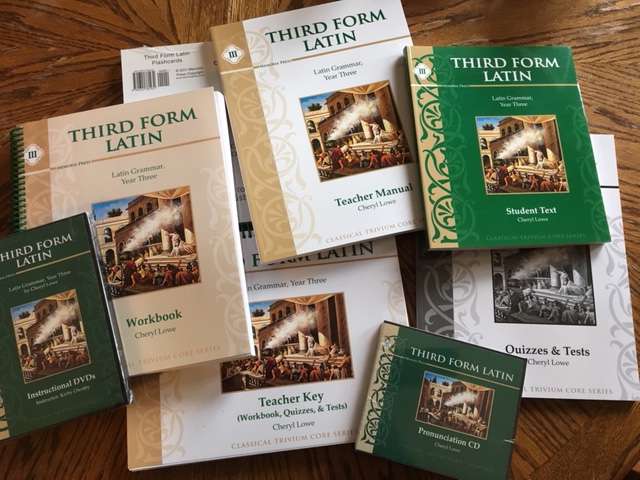
So my box arrived.  I pulled everything out to see what was included.

You can see most everything in the above picture. The complete package comes with Student Text, Workbook, Quizzes and Tests, Teacher Manual, Teacher Key (to Workbook, Quizzes & Tests), Instructional DVDs, Pronunciation CDs, and Flash Cards. The vocabulary flash cards are kind of hidden in the upper left-hand corner. They come as flat sheets, and you can split them all up at once if you want, but I'm only splitting them up a sheet or two at a time as I need them.

I started my time with Third Form Latin by reading the Introduction in the Teacher's Manual and taking a week to do a quick review of some of the Latin I had covered in First and Second Form Latin. It was humbling to me when I read that the First, Second, Third and Fourth Form Latin sets are for grammar aged students (Grades 2-7). I thought this was high school material! The website actually says Third Form Latin is for grades 6-11, so that made me feel better.

I'm struggling so to remember all this Latin vocabulary and the various declensions, different tenses, different cases and genders, etc., etc. And then I remembered that the brains of early grammar students soak up memory tasks like sponges. I wish I had that kind of brain now!

In week 2 of my time with Third Form Latin I started in on Lesson 1, which was, again, more review, as was Lesson 2 (and I needed it!) In general, I thought I would use this format while working on the program: 
  1. Watch the DVD of the instructor teaching the lesson for the week (on Monday);
  2. Read the student textbook chapter for the lesson of the week;
  3. Do one workbook page per day Monday through Friday and review vocabulary flash cards;
  4. On Tuesday through Friday, listen to the pronunciation CD as part of the day's work;
  5. On Friday, take a test or a quiz.
That was my plan, and then Lesson 1 had six worksheet pages! Saturday homework... Then Lesson 2 had seven worksheet pages! I'm not sure how the creators of the program intended this to be used... Initially I assumed one lesson per week, but that had to morph.

So my new plan was one worksheet per day, with a test or quiz on the day of the last lesson worksheet, and start the next lesson the next day with the DVD video.


Each Lesson has a saying that gets memorized with the lesson, in addition to reviewing previous sayings from previous years. I have a funny story about that. When I was almost done with Lesson 1, I ran into a friend that I know knows some Latin. Pleased with myself, I recited my saying of the week to my friend, Brett, to see if he knew it translated to, "I think, therefore I am." He had trouble with it, but eventually translated it. It wasn't until I got home that I realized that instead of saying, "Cogito ergo sum" I had been saying "Cogito est sum", which translates to mean, "I think, you are, I am." What? No wonder Brett couldn't translate it! I laughed out loud when I realized the mistake I had been making.

The Teacher Manual gives a lesson overview broken down into four numbered sections:
1) Greeting, Recitation, Review
2) Latin Saying
3) Vocabulary, and
4) Grammar - Syntax

After the teacher works through this plan each day, the student does the workbook page(s) for the day. The teacher is instructed to do a Final Oral Drill, as in previous Forms, even though this material is not included in the printed materials.

One thing I particularly love about Memoria Press Third Form Latin is the way if you've done the workbook pages, you are able to do well on the tests and quizzes!

As I initially fired up the DVD to watch the Introduction video, I found myself resistant -- the instructor in Third Form Latin is not the instructor I knew from First and Second Form Latin (Glen Moore)! I don't do change well! However, I was liking the new instructor, Kirby Owen, before the Introduction was over. 
I especially like that he speaks a little bit more slowly than the other instructor, Glen Moore. I really had difficulty keeping up with Glen Moore during recitations! So, new instructor, Kirby Owen? Check! I approve! (Don't get me wrong, I love the Glen Moore, too. I was just surprised at how easily I got over changing to a new instructor!)

I want to highly encourage all home school moms to consider studying Memoria Press Latin and teaching it to your children! Latin trains the brain and gives the student grammar and structure that helps them throughout life! It will help them with understanding the English language, it will help them throughout middle and high school, and the vocabulary structure and roots will help them score well on college entrance exams! Or, if you are just a language lover like I am, study it just to study it! I am studying Latin to do something for myself. I'm kind of a "Geek", but I love studying Latin! 

Memoria Press gave members of the Homeschool Review Crew a wide variety of products to review:
To see reviews of these various products, please click the link below.
http://schoolhousereviewcrew.com/spelling-music-appreciation-latin-memoria-press-reviews/


3