Sunday, July 17, 2016

Civil Air Patrol Tri-Wing Encampment


From 6/26/16-7/3/16 my son (and hundreds other young men and women) attended CAP Tri-Wing Encampment in Aberdeen, MD.


Check-in was hot and sweaty in BDUs with a large duffle and additional uniform wear on hangers.


Our cadet checked in, and we said our good-byes.

As the week progressed, Tri-Wing posted hundreds of photos to their Facebook page. We pieced his week together through the photos, and occasionally spotted him in those photos.

The week began with orientation. We see the back of our son's head on the front row.


Here he is again, 5th face from the left.


The cadets were split into Flights - my son's Flight was called Foxtrot. (My son is hidden - he is under the star in the photo below.)


Mornings began at 0-dark:30 with room inspections followed by PT.


Days were filled with book work/study, physical training, volleyball and lectures.


A highlight of the week was riding on a Blackhawk helicopter!


They drilled to parade at graduation. Graduation was 7/3.


My CAP Senior went to the graduation in his blues as well.


My cadet had a great time, but was very happy to be finished to come home and recuperate.

Saturday, July 16, 2016

Fun Word Etymology for my readers


Dynamic Literacy sends out a bi-weekly newsletter about vocabulary. They invited me to share with a friend, so I'm sharing with my readers because I thought this was fun information!

Welcome to issue #39 of Words Matter, our bi-weekly newsletter. Please feel free to share with a friend! 
Here's the good stuff.
From Tires to Tuesdays

Anyone who has a curiosity about words (and who doesn't?) has noticed that sometimes a word has two or more very different meanings. For example, batcan be a stick for hitting a ball or it can be a flying mammal.  Sometimes what seems like a single word is actually two or more completely different words which just happen to look alike.  Word historians, or etymologists, dig into the background of such words to learn why the differences exist.

 A former student of mine, Megan, emails me on occasion with engaging and challenging observations about words.  Recently she asked if I would explain why the word tire (as to lose energy) and the word tire (the thing on the car) look alike. 
I had studied many such examples, but not this specific one, so I eagerly set to work to find out.  This search, as they almost always do, led to astounding language delights, so I thank Megan for the idea in this week's Word Matters newsletter.

The verb tire, as to grow weary, comes from a root that means "to lack, to be without, to need".  So to be tired is to be lacking energy.  A tiresome job, movie, or conversation just doesn't have what it takes. 

That seems fairly straightforward and lackluster, except for a shadowy connection I found with the Greek form (dein-) of this root.  The meaning lacking leads to the meaning of "what is needed", and  almost 200 years ago, philosopher Jeremy Bentham coined the worddeontology.  Deontology is the study of what is socially needful--of never tiring to do what is right.  Use deontology in a sentence today and it will be yours!
 
The noun tire, on the other hand, (the thing on the car), turns out to be a shortening of the word attire (attractive clothing).  So a tire is actually the dressing on a wheel!  If we probe deeper into the history of the word attire, we find a root that means  "order, arrangement, something laid out in display".  It's then easy to see the basic meaning of the related word tier, like the layer of a cake or a level of seating.

Let's keep going.  At the base of "order, arrangement, display" is the sense of "attractiveness, shine, and glory".  That sense shows up in the name of one of the ancient Germanic deities, Tyr, so the car's tire (spelled tyre in British English) is more exalted and divine than we knew.  No wonder some people take such pride in their wheels!
The two words tire, then, are originally two completely separate concepts from two completely separate roots, but they have emerged in modern English as looking and sounding the same.  That's not always what happens, and we will explore more examples in later blogs.  But as you can see, tracing word history exposes astounding layers of meaning in ordinary words and is always a source of delight. 

One last thing.  We modern English speakers tirelessly commemorate that ancient Germanic deity Tyr four or five times a month.  His name shows up every Tuesday.
--R. D. "Doc" Larrick
 

Enjoy this brief student video that comes directly from WordBuildonLine Foundations Level 2. 
The prefix INTER
The prefix INTER
Please add our email address to your address book to ensure that you receive these emails and stay in the know. 

Jerry Bailey
President & CEO

Parents & Home Educators 
SAVE 10-25%
Take 10-25% off your purchase

Use coupon code NEWS16 to save 25% on WordBuild Books and 
CDs, and 10% on WordBuildOnLine

Only valid for prepaid orders.
Join Our Mailing List


Tuesday, July 12, 2016

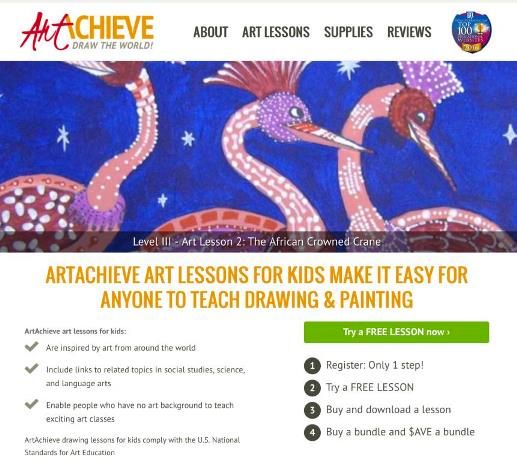
ArtAchieve - A Schoolhouse Crew Review

Review Crew

In late May I learned I would be receiving ArtAchieve to review.

We received a full year's access to ArtAchieve Entire Level III for our family.

There are so many ways I could begin discussing this product. In thinking about how to start last night, I decided I want to list the projects included in Level III.  So here's a list of Level III projects:

Lesson 1: The Hawaiian Frog

Lesson 2: The African Crowned Crane

Lesson 3: The Chinese Horse: Drawing the Horse’s Head

Lesson 4: The Face From The Gambia

Lesson 5: The Pacific Northwest Totem Pole

Lesson 6: The Eastern European Firebird

Lesson 7: The Wood Carving from Kenya

Lesson 8: Kandinsky and Color Mixing

Lesson 9: The Nine-Banded Armadillo

Lesson 10: The Russian Matryoshka

Lesson 11: The Canada Goose

Lesson 12: Da Vinci’s Clock

If you were using this for your school year you might choose to do two projects some months, one project in some months, to spread the lessons out over a ten-month school year. There are six levels, and they can be used by a wide range of student ages. You can have all your students working on the same level each year or have different levels to use with different students. Or, if you have an older student like I do, you might start the school year with one level, complete that level in one semester, and use the next level for the next semester. If you wish, you can also just pay for the individual lesson(s) you want instead of using the entire level. There are also free lessons available on the website. Some of the free lessons on shading look like lessons my oldest received in art when in college!

I love the cultural diversity I see in Level III's lessons - Hawaiian, African, Chinese, Gambian, native American, Kenyan... You can read the above list. Great variety. And the 12th lesson... I love Da Vinci!

As the teacher opens a lesson, there is a menu that drops down. The lessons include:
  • Lesson Warm Up;
  • Powerpoint presentation;
  • Video Lesson;
  • and a project printout.
The project warm up gives a print out that breaks the art project down into six segments. The student gets a chance to practice the lines and angles that will be used when he starts the project drawing. 


The video lesson is very student-friendly. I did use the pause button liberally. The power point presentation is also excellent. For several lessons I looked at both. My son, though, just likes videos, although the (fun) sound effects aren't his style. I ultimately decided I like the videos best, personally. The presentation is broken into what you'll learn, what you'll do, what you'll need, what to do, etc. It is very well done.

The lessons in Level III also encourage use of a wide variety of mixed art mediums. Projects are planned for use of oil pastels, acrylic paint, pencil, colored pencil, magic marker, foil-glue-shoe polish, gel pens, water color and layered cardboard.

Lessons begin with warm up, music and mental settling.
There is a button on the menu bar for "Supplies" with a drop-down menu where you can purchase music to listen to while working. Lessons teach background of the art project and style, and sometimes geography and things about the region. The instructor walks the student through drawing the subject,

and then painting the drawing.

Lessons conclude with reflection about the project.

Initially I thought I would pick my favorite project to begin, but in the end we just started with Lesson 1 and worked through lessons in order. Since we've only had the material about six weeks, we haven't done all the lessons. I've looked through them (quickly), though, and have my favorites. I'm looking forward to the armadillo!


What you experience as you work your way through a lesson is that this program is giving you the opportunity to do unit studies, not just study art. For example, lets consider Lesson 1, the Hawaiian Frog. At the beginning of the lesson you are shown a cement garden statue/fountain of a large frog.


You have the opportunity to teach your student about Hawaii (Geography) and frogs (Science).


Ask them to write a report if you want documentation. You can also introduce spelling words. Listen to music while you work and you are covering music. You might not count it, but determining picture placement and the "Rule of 3's" with oil pastels and you are using Math.


As for Art instruction, the student is walked through preparation,


"Rules for Drawing",


the initial drawing, 


determining background behind the drawing, and various ways to finish the drawings (each drawing teaches different mediums and techniques).


In summary, Art Achieve is an amazing product. I've been really impressed with it and I encourage you to take a look at it and give it a try. You can start with some of the free lessons!

Other members of the Review Crew also reviewed this product. To see other product reviews, please click the button below.
Art Lessons for Children ArtAchieve Review

Crew Disclaimer

Monday, July 11, 2016

Menu Monday 7/11/16

Did you notice I didn't post a menu plan last week? What a difficult week that was for us, each day trying to figure out what we would/could eat that evening. ::sigh:: Don't want to have another week like that again soon...

So this week I'm only cooking for two. Here are my plans:

Saturday (7/9):
B: blueberry morning
L: salad

D: lime chicken, rice, broccoli

Sunday (7/10):
B: spinach omlette, bacon
L: salad with diced chicken
D: reuben sandwiches

Monday (7/11):
B: blueberry morning
L: salad with tuna
D: salmon, kale, yams

Tuesday (7/12):
B: fast for bloodwork
L: green almond smoothie
D: beef enchiladas

Wednesday (7/13):
B: spinach omelet
L: salad with avocado and egg
D: turkey cutlets, noodles, green beans

Thursday (7/14) (CAP):
B: blueberry morning
L:  salad with tuna
D: grilled cheese sandwiches, soup

Friday (7/15):
B: spinach omelet
L: salad with chicken
D: White Bean and Vegetable Soup

Saturday (7/16):
B: blueberry morning
L: salad with chicken
D:  grilled chicken, broccoli, corn 


3