We got into the car and headed to the local park. While sitting cozy in the warm car, I opened Handbook of Nature and read the section about thistles (page 524). While reading, I decided I had gone to the wrong park, because the thistles need to be undisturbed for two years to flower, and looking around I determined the park I had gone to was too well manicured to have first-year thistles, let alone two-year-old thistles in flower...
So we got back in the car and went to a different, closer to nature park, which turned out to be perfect. There were thistles everywhere!
First we took a small sample from the above plant. (Sorry, we really didn't want a 3' specimine to come home with us...). Then we walked to see what else we would find. Actually, some of the specimines were 5' tall!
After investigating thistle specimines available, we walked a ways down the path. I photographed other notable wildflowers:
I was thinking this one might be teasle.
This one was so light and fluffy! And beside it was some wild blackberry.
My son found this area to be a haven for grass hoppers, and quickly grabbed a trash cup out of the car to collect as many as he could catch! Some of these grass hoppers were 3" long! Those big ones wouldn't sit still for their photograph, though. But this one sat for a photograph:
Having the gloves, because of the thistle hunt, was actually so helpful! My son was able to pounce on whatever grasshopper or spider he wanted to.
We also saw, very close up, a turkey vulture. But, unfortunately, when the bird was close my camera was ready, and when my camera was ready, the bird refused to come back. Go figure.
It was 4:30 in the afternoon, and it was so weird to find the moon was out!
I found some tulip poplar leaves, but as the sun was starting to go down the photo didn't turn out very well.
I also saw some deer, but they didn't get close enough for me to photograph. Also, there was an amazing little bird that kept teasing me. We thought at first he was a humming bird, but he wasn't. He was small, green, with gray stripes on his wings. He wouldn't stay still for me to photograph, and blended in so well that half the time when I could see him with my eyes I still couldn't find him through the viewfinder of my camera. I don't know if I could actually identify him if I found him in a book or on the web, but I might try.
So, we had a very nice nature walk, starting with the thistles. Looking forward to next week already!
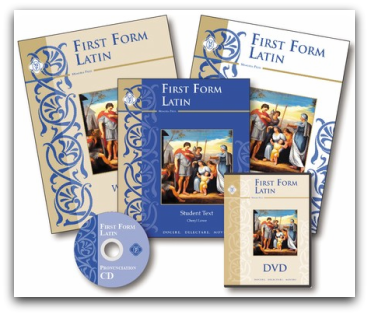
I was blessed, recently, to receive First Form Latin, by Cheryl Lowe, from Memoria Press to look at to review. First Form Latin is for students who begin their formal training in Latin when they are in Grade 5 or higher. Students who begin the study of Latin in 1st through 4th Grade would begin Latin using Prima Latina, and those who begin the study of Latin in 3rd through 6th Grade would begin with Latina Christiana I. If you look at that closely you will see that there is a lot of flexibility in which Latin program to start with. In addition, the parent knows their own child and might decide on Prima Latina for a 5th Grader, or an advanced 4th Grader might start in First Form Latin if they are up to the challenge!
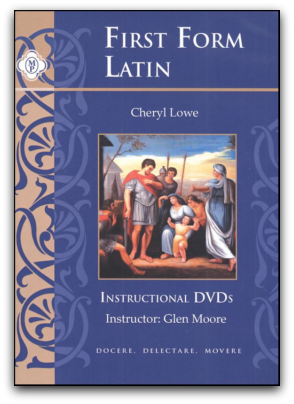
I was so totally blessed when I found that Memoria Press sent me the complete "First Form Latin Plus", which includes the Teacher Manual (soft cover), Teacher Manual: Workbook & Test Key (soft cover, spiral), Student Text (soft cover), Student Workbook (soft cover, consumable), Quizzes and Tests (soft cover, consumable), Pronunciation CD, Latin Flashcards, and DVD set! This complete set sells for $115.
Homeschools can purchase a First Form Latin package that includes only the Teacher Manual, Student Text, Student Workbook, Quizzes and Tests, and Pronunciation CD, which sells for $55. I don't see, though, how the average homeschool mom who knows no Latin can possibly be successful without the DVD set, though. My advice would be that this less expensive set would be for someone experienced with Latin themselves. Someone with no previous Latin education themselves should seriously find a way to buy the "Plus" set, to ensure a successful Latin program in their home.
I had to figure this out so that I could make an official announcement. I have decided that I am a linguaphile, particularly of Latin. From the very first Lesson, I am learning. (Yeah, I know, this was supposed to be my son learning, but he's going to start it after I get a better footing so that I can better support him in his studies.)
About 20 years ago, I learned the chant: "amo, amas, amant, amamus, amatis, amant". I knew it was the root word for "love", but I knew nothing else. (Suffice it to say I was trying to teach Latin to a different child using a different Latin program."
In my opinion, this program starts out a little rocky. I began by watching the DVD Introduction and Lesson 1. The instructor asks the student to open the textbook, and the DVD lesson follows the textbook. The instructor explains how to do the Lesson 1 conjugations (1st Conjugation, Present Tense) before the next lesson. He instructs the student to work on memorizing the word charts in three different ways: endings of the six conjugations by themselves (-o, -s, -t, -mus, -tis, -nt); the endings attached to an example verb (am-o, ama-s, ama-t, ama-mus, ama-tis, ama-nt); and the student is to memorize the meanings (I love; you love; he, she, it loves; we love; y'all love; they love). What is recited will change as different verbs are introduced, and the student is supposed to work on learning the new vocabulary and all the declensions and everything quickly. He goes over Lesson 1's new vocabulary and instructs the student to make conjugation charts for all the new Latin verbs that are introduced in Lesson 1 of the Textbook.
That is a lot to work on until Lesson 2 next week, but as I worked on the conjugations I found that the process really was beneficial. But I looked at my materials to go with the program only to find that there were more materials that looked like they were meant to be used that he had not mentioned: the Workbook and the Flashcards So, I looked over the workbook only to find that not only would there be 4-6 pages in the workbook for each week's lesson, but also there were pronunciation pages that needed to be studied to answer the workbook pages about pronunciation that came before the Lesson 1 workbook pages. (I haven't even figured out how I will integrate the flashcards, yet.)
In addition, there is a pronunciation CD to be used each day between lessons to help the student with the pronunciation and each weeks' recitation. (I think he mentioned this somewhere in the DVD lesson, but did not mention it at the end where he seemed to be summarizing what the student needed to do on his own before the next DVD lesson.)
What I'm saying is that it would have been very helpful if the DVD had covered the use of the Workbook, Pronunciation recording, and Flashcards, giving the assignment to go through the pronunciation pages in both the textbook and the workbook, as well as the recitation CD, as part of the assignment for Lesson 1. Even if these are optional, it would have been helpful for them to be mentioned for those who are using them...
That said, I did my conjugations and listened to the recitation recording. Ideally the student would listen to the recording daily through the week while working on/reviewing daily on the conjugations and workbook assignments, and do a new lesson on the same day of the following week, working on each lesson for a week with incremental daily assignments and repetitions of recitation. However I have a whole year's curriculum to review and only have had the material for about a month, so I need to abbreviate what I do to give you the review.
This is actually a partial lesson. While watching the DVD lesson, the student would follow along in the Student Textbook. Following the lesson you would conjugate the verbs in the lesson's vocabulary list. The work in the lesson can be spread out through the week, but the student would work through all the material, as well and do the pages for Lesson 8 in the Workbook. The teacher actually begins the workbook pages with the student, working from the Teacher Manual, until the student understands what is required and can try to complete the rest of it on his/her own. Throughout the week the student works on the week's Oral Recitation to prepare for the next lesson. The student should listen to (and repeat after) the pronunciation recording, possibly daily, to help cement it all in. I did notice a link to Corrections in First Form Latin, which I am printing out so I can go through my book and make the corrections.
First Form Latin comes broken down into 34 Lessons. Since there are 36 weeks in a school year, this means you can take two weeks for a couple of lessons, or take the first introductory week to do the Pronunciation work before Lesson 1, but I don't think that is necessary. It's nice to know there is a little "wiggle room" in case you get sick or off schedule, so you can still finish close to when you originally planned to.
So far, I am really liking the results I am seeing. So, here are what I liked and what I didn't like.
What I liked:
This program is thorough. If one follows the Memoria Press Latin program through all four years, the student will come away from the program really, really reading Latin. The student will be able to pick up Latin manuscripts and read the book in Latin, for books like Caesar's Gallic War, and any other books in print in the original Latin.
The program teaches the student to learn how to learn. The student needs to recognize that it is their own responsibility to learn, to apply themselves, to work hard, to achieve goals, to seek excellence in themselves.
What I didn't like (or what someone might not like):
As I mentioned above, when you are first beginning the program it is hard to figure out. Things are not as spelled out as they could/should be. If the week's assignments include conjugating, memorizing, pages in the workbook, listening to the recitation tape, and practicing with flash cards, then the DVD should not only say the first two. Or, if everything else is optional, the DVD should still mention what *could* be done when, so that people who are trying to use each item know when to implement them.
The teacher on the DVDs goes really fast! What I mean is this: he speaks the Latin, and the student is supposed to repeat the Latin after the teacher speaks. However, the teacher barely gives the student time to repeat what he says. If the DVDs were actually recorded in a classroom setting, I think the teacher would have realized this, but without the students attempting to repeat in his presence, I think he forgets this. The student can get around this by getting in the habit of speaking with the instructor instead of trying to repeat after the instructor finishes speaking. (There are sections where the student can know what the teacher is going to go over).
Finally,
Because of all the different modalities used in First Form Latin Plus, I believe it would be a good program for students of all different learning styles.
Although, with a motivated student, this program could be successful with little to no teacher preparation and participation, I believe the student (and the teacher) would benefit from the teacher watching each DVD lesson in advance, as well as participating deeply with the student while working through the different facets of each lesson.
I believe this product would be considered "Christian" in nature, but I have not encountered any aspects of the program that I believe would be offensive to someone approaching it from another persuasion. Much historic Latin is Catholic in origin, owing to the history of the Middle Ages. This is just a fact.
So far I have been working through the program on my own, because of my own personal interest and for my own continuing education. Soon I will begin to introduce this to my 6th grade son. I might spread this course out over two years for him, but I hope to continue on through all four years of the Latin program with him to enable him to be fully fluent in Latin by the time he graduates. (And I hope to be fully fluent with him! How cool will that be!) So, yeah, I love this program.
Disclosure: I received a free copy of First Form Latin Plusin exchange for my honest opinion and review. I received no other compensation (other than the aforementioned), and this page contains my honest opinions.
This has been a TOS Homeschool Crew Review.
To read more reviews of this product, visit the TOG Crew Review page for this product.Throw me a bone! Leave me a comment! I love comments!
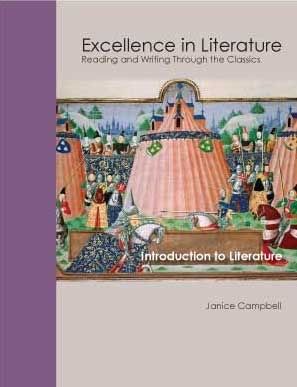
...a product line called Excellence in Literature, by Janice Campbell. The specific product I was given to review was called Introduction to Literature - which is a college prep course in literature for the 8th grade level.
If you have been reading my blog for any time at all, if you have ever read my profile, then you will know that my homeschooling philosophy is a complicated mix between Charlotte Mason and a Classical Education approach. Because of that, I have been totally intrigued and delighted by this
product!
My son is not in 8th Grade yet, and for this year we are already firmly enmeshed in our current year’s literature curriculum for 6th Grade. For that reason, my review will be more of a personal review, rather than a review of, “This is what we did, and here is how it went…”
That being said, I can very easily look at this curriculum and envision choosing to use Excellence in Literature for 8th – 12th Grades, to give my son an excellent grounding to prepare him for college. And the thought excites me because of what I have seen!
The Excellence in Literature program, a five year program of reading and writing through the classics, offers the following courses:
Each year's plan is broken into nine 4-week units. For Introduction to Literature, Unit 1 contains short stories, and the units 2-9 are each devoted to a key piece of great literature from the western literary tradition: Around the World in Eighty Days (Jules Verne); A Connecticut Yankee in King Arthur's Court (Mark Twain); Jane Eyre (Charlotte Bronte); Pygmalion (George Bernard Shaw); Treasure Island (Robert Lewis Stevenson); Animal Farm (George Orwell); The Tempest (William Shakespeare); and Gulliver's Travels (Jonathan Swift).
Even within each of the above units are instructions on how to adjust the unit if the student wishes to take an AP or CLEP test at the end of the year. (An AP test can give the student up to .5 more points on their grade, so a 4.0 in English Lit. can become a 4.5, which helps overall grade point average. A CLEP test can get a student college credits for work done before enrolling in college.)
Even before introducing the student to the great works themselves, though, the author does an excellent job of explaining to the student what his/her responsibilities and goals are. The student taking this course is going to learn how to learn, so he doesn't have to be spoon-fed, so he knows how to dig in and tackle new material without a teacher/mentor prodding every step of the way. The author wants the student to understand that this is his responsibility. The importance of understanding the historical context of the work is explained. I wish, when I was a student, it had been explained this way to me. I remember thinking, as the setting of a work work was explained, "Stop talking, already, and let me read the book!" In my education I had learned that "getting it done" was the goal, not literary understanding.
Steps and procedures are laid out in the beginning chapters instructing the student to set up a notebook, divide it into certain sections. The student is instructed to read with 3x5 cards, write down new words, look them up.
The introductory chapters are key. The whole process is seeking to get the student to understand the importance of and take responsibility for their own education with the goal that they become a life-long learner.
From the book:
"The Learning Process: The Roles of Excellence in Literature, the Student, and the Writing Mentor
"This book will:
• Establish the scope and sequence for the class.
• Assign appropriate readings.
• Provide a suggested schedule for assignments.
• Provide time management and organization tips.
• Provide a rubric for objectively evaluating completed assignments.
"The student will:
• Study this book and understand the sequence and timing
of assignments.
• Ask questions of the writing mentor when something is not
clearly understood."
The writing mentor will provide follow up and feedback on writing assignments, accountability and grades.
The curriculum provides historical context for the assigned literature, instruction for literary analysis, and assignments for writing assignments. The great works themselves, however, are not included. Janice Campbell recommends purchase of books, so the student can mark in the book while reading, applying what is defined as literary reading. (Libraries frown on readers doing this to library books... ) Even with books, the author is able to recommend certain publishers, steering the reader toward well produced versions with a good introduction, possibly a small author biography, and print that is not hard to read, margins that are large enough to make notations in.
Introduction to Literature itself has only 139 pages, which is broken down into 27 sections... not exactly chapters... Nine are the actual units, but before the units there is a section providing valuable information to the student, and after the units are sections of resources, tools, and important information to help the student with the various different writing assignments.
There is so much to this book I cannot possibly cover it all in this review without your eyes glazing over. But Andrew Pudewa, from the Institute for Excellence in Writing, created a video to tell about the course, which is a much better medium. It is a "Viddler" video, not "YouTube", and I can't figure out how to load it to my page, so I'll just have to link it: Andrew Pudewa on Excellence in Literature
There is so much about this curriculum that I like. I really straddle here between Charlotte Mason and Classic -- Charlotte Mason promotes slow reading with careful digestion of the material; Classic methods promote in depth study of a work that you read fast and then go back and re-read while you analyze. I love the way this curriculum brings the homeschool to a higher level of educational excellence.
The only thing I dislike, which isn't the curriculum, but only the form I received, I dislike having the material in PDF form, because now I need to print it out. (If I had it in print form I would probably be dissatisfied with it because then it wouldn't be searchable... Maybe I just want both print and PDF format...)
In many ways this requires very little teacher prep and hands on work. In other ways the teacher's job goes to whole new level as writing mentor, unless an outside service is used, and options for that are mentioned in the curriculum. Many moms are scared to death at the thought of grading their own children's high school writing assignments, even though clear rubricks are provided showing the student what is expected and showing the parent-teacher how to score different aspects.
If I have at all intrigued you, then why not take a closer look? You can download a free sample unit! Take a look at the material, and then come back and leave me a comment so I know what you thought.
Introduction to Literature is available from Everyday Education for $135 as an e-book, or in print form, in a big, beautiful, professionally printed binder with tabs, for $139 (plus shipping). I received the e-book, but I'm sure wishing I had the printed version, because I'm going to spend a ton printing this out!
In addition to the Excellence in Literature Series, Everyday Education also carries:
Disclosure: I received a free copy of Introduction to Literature in exchange for my honest opinion and review. I received no other compensation (other than the aforementioned), and this page contains my honest opinions.
This has been a TOS Homeschool Crew Review.
To read more reviews of this product, visit the TOG Crew Review page for this product.
Throw me a bone! Leave me a comment! I love comments!
When we were first told that Marshall Publishing's Lots and Lots of Firetrucks was going to be coming up for review, I was skeptical. It looked like something that would be most appropriate for pre-school and early elementary.
But I looked at the information, and it said it was for 4th - 8th graders, so I signed up as being interested. After all, my son likes fire engines, and he is in 6th grade.
I was selected for the review, and when the materials arrived I popped the DVD into my computer with great anticipation to view it once on my own (with earphones) before showing it to my son. Well, the DVD, called Lots & Lots of Fire Songs and Safety Tips definitely was lots and lots of fire songs. I kept looking and looking to see if there was something more, something I was missing, but I saw it all. It was just lots and lots of songs. And I was fairly certain it would bore my so to tears, but I said nothing because I didn't want to influence him.
So I told my son that we had this firetrucks DVD to watch, I plugged it in and sat to watch his reaction. Well, he reacted the way I had anticipated he would and did and did not tolerate to watch the entire DVD. Within the DVD there seemed to be too much repetition, and the songs seemed of a nature for younger children. Some of the children in the DVD actually were younger children, telling safety tips (which said to me that their audience should have been younger children). There was even one place in the DVD where the child giving advice said that if there is a fire, go to a pay phone and dial 9-1-1, and you don't have to pay. Well, the last time I checked AT&T had done away with all pay phones, and so the section in the DVD about using a pay phone is moot. But this DVD would have a lot of appeal to kids just a wee bit younger than my son, who is almost 12...
So, having cemented my opinion that Marshall Publishing Company should be marketing the DVD to younger kids, I then turned my attention to the book, Fire Trucks & Fire Fighters. This beautiful, soft-cover, bright colored book has 124 glossy pages full of beautiful color photographs. I was writing up a description, but it got cumbersome, so I'll list the contents so you can get a flavor of what it contains:
Words of the Firefighter: Fireman's Prayer and others
Old Time Firefighter's Alphabet
Classic Fire House Traditions;
History of Fire Trucks and Fire Fighting
Antique Fire Trucks;
Greatest Fires in History;
Firefighting Timeline;
Fire House Museums;
Cool Fire Related Websites;
Lots and Lots of Fire Trucks Sing-a-long Lyrics
Conclusion
It is a beautiful book. And I really do like the book--better than the DVD. I will definitely be trying some of the recipes the book provides. There is new information here, and there is fire safety information and history here that will be new to my son. All that said, I still don't think Marshall Publishing has this designated for the correct age. For instance, if you have a 5th or 6th grader, and it is your youngest child, and a child who has, for the most part passed beyond being interested in fire trucks, I'd say this is not a set you should consider.
However, if you have a whole passel of kids, and your oldest is 4th-8th grade, by all means go ahead and invest in this. The language in the book is advanced for younger kids to read it to themselves, but it would be a wonderful book to snuggle together on the couch and the older person read aloud to the younger ones. It really is a beautiful book! I will definitely be recommending this entire set to my friends with young kids with an interest in fire trucks!
So far, I watched the DVD with my son as a test, because I was fairly convinced he would not like it, and I was right. I have, since, reviewed the book on my own, and I have come to the conclusion that he is going to enjoy looking it over, but he won't choose to spend much time on it on his own. I plan to schedule parts of it to include in our homeschooling, which we will label as "Health - Fire Safety" (since in my state I am required to document that I teach "Health", and I believe Fire Safety easily falls into that category). Many of the fires mentioned in the chapter on great fires in history are ones we have studied in the past, and others are ones we will cover in the future. So we will take a look at the timeline and plug some of the historic fires into our Book of Centuries, which is our timeline that we are building on this year in our homeschool.
My opinion is that this DVD and book set should be marketed, in general, as a book for reading aloud to/with kids preschool through 4th grade.
So check out their extensive offerings, and tell your friends about all their great products. Christmas is coming, and if you have a passel of kidlets who just love planes, or trucks, or trains, or certainly fire engines, consider buying them one of these packages since they are such a great deal now!


 I was thinking this one might be teasle.
 This one was so light and fluffy! And beside it was some wild blackberry.


 I also saw some deer, but they didn't get close enough for me to photograph. Also, there was an amazing little bird that kept teasing me. We thought at first he was a humming bird, but he wasn't. He was small, green, with gray stripes on his wings. He wouldn't stay still for me to photograph, and blended in so well that half the time when I could see him with my eyes I still couldn't find him through the viewfinder of my camera. I don't know if I could actually identify him if I found him in a book or on the web, but I might try.