Friday, October 28, 2011

Outdoor Hour Challenge

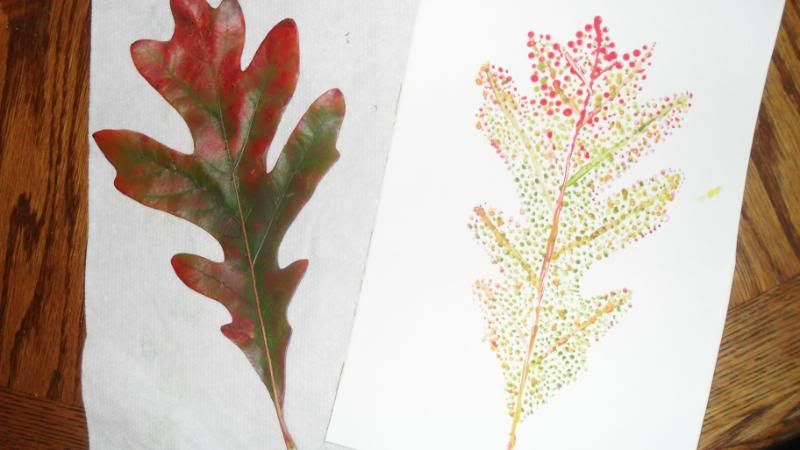
We do Nature Study on Friday Afternoons from 3:30-5:00 p.m.  Study of nature is combined with art to create entries into our Nature Journals. I try to follow Outdoor Hour Challenges, but this is the first time I was able to actually correlate to the one Barb was listing on the week it was listed!

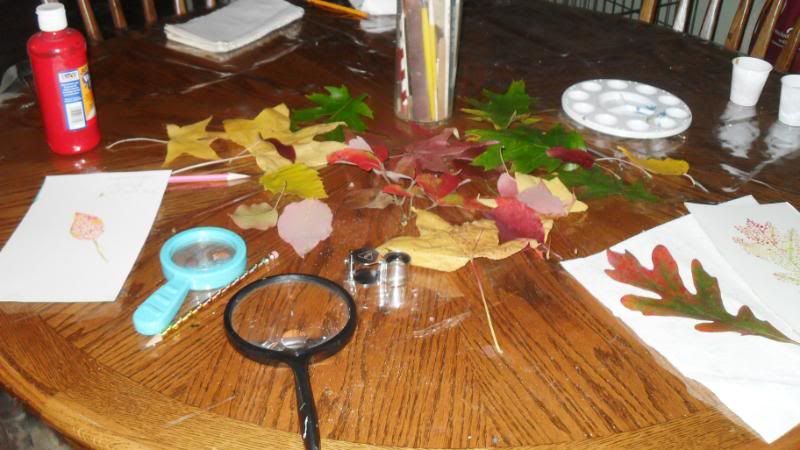
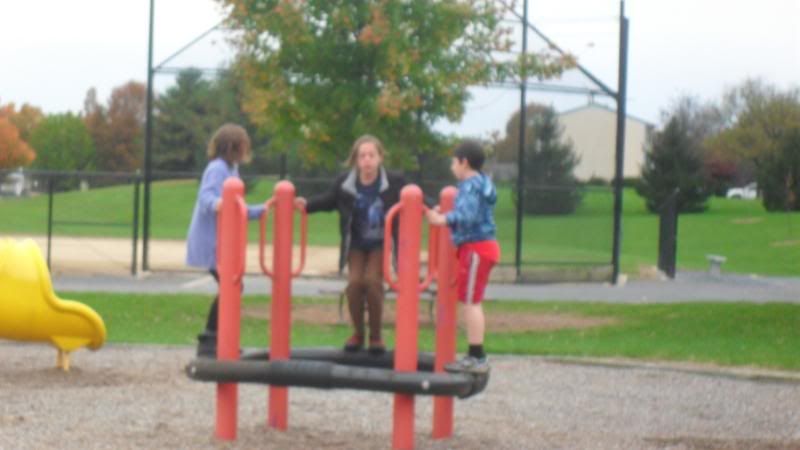
We started our nature challenge by getting in the car and driving a short distance to some local trees, to collect photographs and leaf samples for our challenge. Took photos of the trees, but they are all showing sideways on the blog and I don't know what I'm doing wrong...  Anyway, we selected specimines and brought them home to examine them, because it's getting cold out there this late October day. At one point leaf collection was reduced to playtime, but it's all good CM outdoor time, so it's all good.


The leaves were examined under looking glasses.
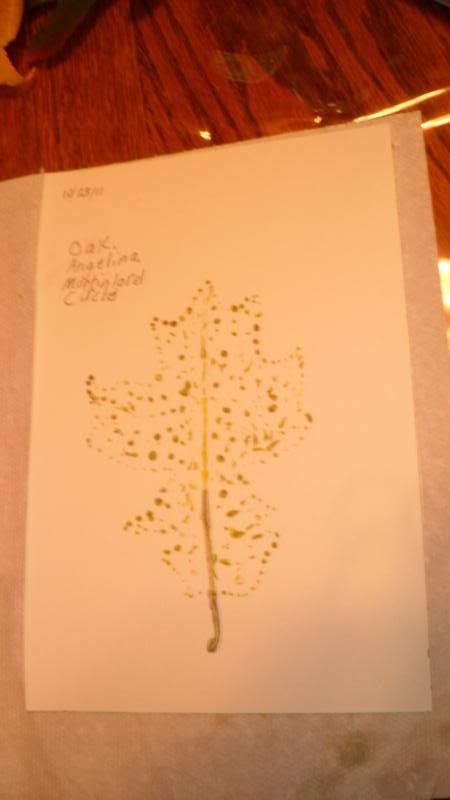
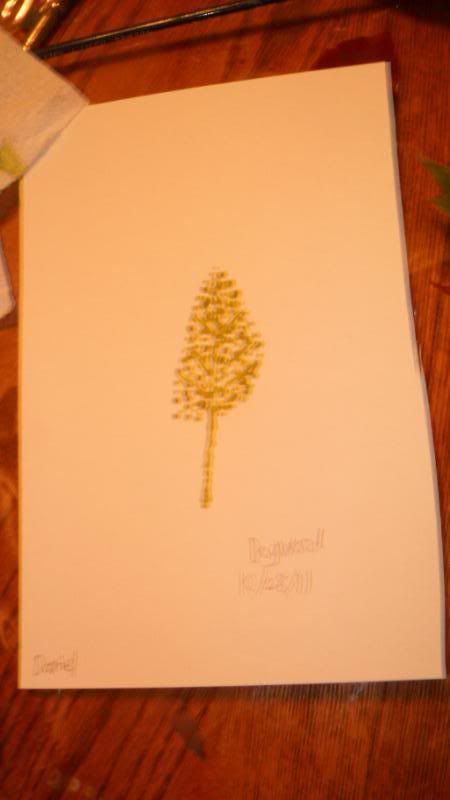
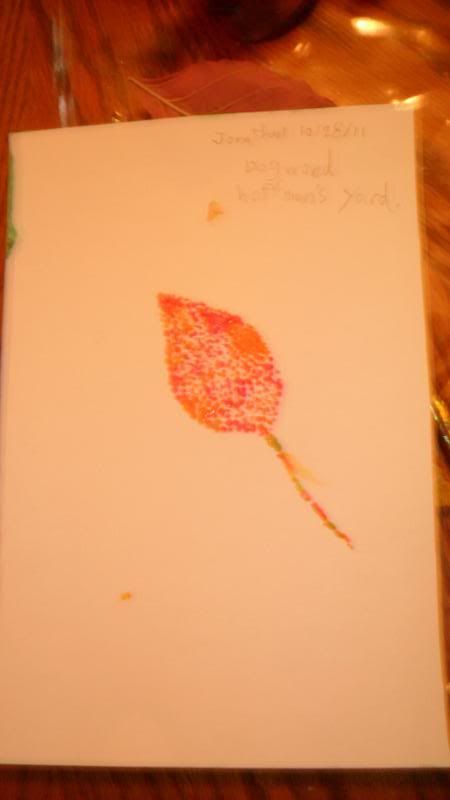
 Then I brought out an artist book on impressionism and discussed painting in pointilism. We also experimented with blending colors to get different shades and tints. We had difficulty getting a good shade of green for some reason. We each selected a specimen to paint, and painted it using pointelism.

The last painting is mine. I always paint, too, to show my students I care and that I consider this important and not something I want them to blow off or fool around with. I was pleased with all the paintings today and the effort that the students took.

Thursday, October 27, 2011

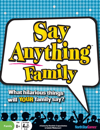
Say Anything Family Game

I recently received Say Anything Family game to review for Northstar Games.

Say Anything Family was just released for 2011. I have never played the previous version that did not have "Family" attached, but I can only imagine that the questions in this version have been adjusted so that they are more appropriate for kids.

Say Anything Family is a game for anyone ages 8 and up. It is a game for 3-6 players, and more can play by breaking off into teams. The game comes with:
• six Answer Boards and six little dry erase markers;
• a "Select-o-Matic 6000";
• 2 Player Tokens per person (12 total);
• a Score Board;
• a stack of Question Cards with 6 questions to choose from on each card (a total of 360 questions);
• a sheet with directions and a sheet with information about other Northstar Games.

It takes about 2 minutes to learn to play, and about 20 minutes to play (the box says 30 minutes, but that wasn't my experience).  To play the game, each player receives an Answer Board, a dry erase marker, and 2 Player Tokens, all color coordinated. A Score Keeper is selected, and the Score Board is placed where the Score Keeper can easily tally the score each round.


The youngest player gets to go first. The Select-o-Matic 6000 is given to this player, with a question card, and he/she picks a question to read. Each person puts an answer on their Answer Board. The Answer Boards are all put into the center of the table. The person who read the question picks the answer he or she likes best by turning the arrow on the Select-o-Matic 6000 to the color code for the Answer Board of that answer and placing the Select-o-Matic 6000 face down on the table. [In the beginning it is easy to mistake the Select-o-Matic 6000 for a spinner, but it does not spin that way and is not intended to be used as a spinner.] Then each player uses Player Tokens to guess which answer the question asker chose. In this photo, the sample question was, "In my opinion, ...If I could have any middle name, what would it be." So the guesses need to be made based on what the players think the question asker would like to have as a middle name.


At this spot, the Select-o-Matic had not been used yet, and it should have been upside-down.

The question asker then turns over the Select-o-Matic 6000 so everyone can see how they did, and the scores are tallied. One point goes to the person who wrote the answer that the question asker liked best, and one point goes to each person who had a Player Token on that Answer Board. The score for each player is added to the Score Board.


The next question is read by the person to the left of the previous question asker, so the Select-o-Matic 6000 is also passed to that person. The game is over when each person has asked a question twice, and the winner is the one with the highest score. In the event of a tie, the younger player is the winner.

My son has said several times now, "I really like this game!" This surprised me a little bit because my own personal opinion was a little less favorable. Maybe I have just been in a contrary mood when I have played, I don't know, but when I get the question cards I have had difficulty deciding on a question that I really cared about. And I have had difficulty having an opinion on the questions. For example, here are some of the questions that I just didn't even care about:
In my opinion...
• What's my biggest pet peeve? (Do I have a biggest pet peeve?)
• What's the best video game ever? (Do I even have any idea?)
• What would be the coolest thing to do with a $100 million lottery jackpot? (Like you would only do one thing with all that money?)

So, I was probably being ornery. Here are some other sample questions that are fun:
In my opinion...
• What's the best toy of all time?
• What's the most important invention of all time?
• Which TV show prop would be the coolest to own? (I definitely said the Tardis!)

So overall this game has been a hit in our family. Here are things about it that I liked:
• It's fun to have a game that you write on/wipe off with a napkin;
• It's quick and easy to learn; quick and easy to play;
• This game is so easy to play that my son can easily take it out on his own and play it with his friends. (We own some games that I never want him to play without an adult present.)
• This game is in depth enough that it can interest players of all ages.
• I like the neat make-up of the box for storing the game in.


Things I didn't like:
• Well, like I already said, I didn't like all of the questions so well. If I were going to change anything, I would probably do the questions differently. I think basically I probably prefer factual questions to opinion questions, so the problem is probably with me, not the game.

I would generally recommend this game to anyone as a good family game. I like for families to play games together, so I would recommend this to most families to add to their game selection.

Say Anything Family is available from Amazon.com for $13.85 (and Super-Saver Shipping is available). It would make a great Christmas gift.

The makers of Say Anything Family, Northstar Games, also makes the original Say Anything game,  Wits & Wagers Family, and the original Wits & Wagers game (less suitable for young children).

Disclosure: I received a free Say Anything Family game in exchange for my honest opinion. I received no other compensation (other than the game), and this page contains my honest opinions.

This has been a TOS Homeschool Crew Review.

Photobucket
To read more reviews of this product, visit the TOG Crew Review page for this product.

Throw me a bone! Leave me a comment! I love comments!

Tuesday, October 25, 2011

Wits and Wagers

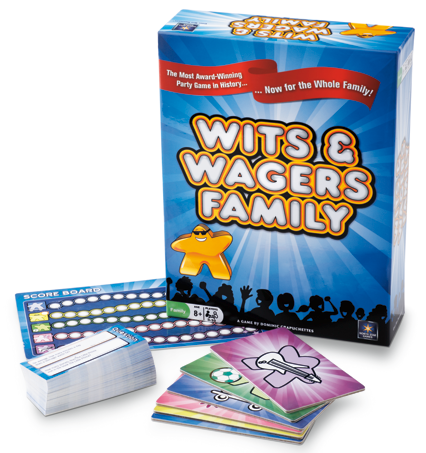
Wits and Wagers Family is a group game made by North Star Games.

I had the privilege to review a game by North Star Games, called Wits and Wagers Family Game. What a delightful, refreshing game! Very quick and easy to learn; very quick and easy to play!


Here are the specifics about this game:
• Wits and Wagers Family is a game for ages 8+.
• It can be played by 3-10 players, making teams if you have more than 5.
• It only takes about 2 minutes to learn how to play.
• It only takes about 20 minutes to play each game.

The game comes with 10 little "meeples" -- I generally explain them to new players as "Me-peoples". There are two sizes -- one counts as 1 point if it is on the correct answer, and one counts as 2 points. The box also contains a score card, five "guess" boards, with a sixth similar board that has a "1" on it, and six dry-erase markers.

Basically, there is a box full of questions -- question on the top side of the card, answer on the bottom. One person takes "scorekeeper" responsibility. The youngest person reads the first question, and each turn thereafter the questions will be passed to the person to the left. When the question has been read, each person guesses the answer, which will always be a number, and writes guess on "guess board", and turns it face down. When all are done guessing, the boards are flipped and put in ascending order from the "1" board. Then, with all the guesses showing, people decide which answer is correct by putting their meeples on the boards. You can put both on one board or split them up. Then the answer is read. The board with the closest answer (that doesn't go over) is the winning answer. The person who guessed it gets 1 point for that, and then any little meeples on the board score one point, any big meeples on the winning "guess" board get two points. First person to score 15 points on the score card wins.

Good points:
• Easy to learn;
• Easy to play;
• Good solid construction
• Cool little dry erase markers;
• Meeples are fun!

What I would change:
• I think it should be marked for 2-10 players. I didn't open it for a long time because it said 3-10 players, and there were so seldom more people than my son and I when game time arrived;
• It would be nice if they include 5 little ...sponges or erasers... for the dry erase boards. We were wiping the marker off with our fingers and finally I decided to rip up a paper napkin so we each had something to erase with.

What I might do with this game in the future:
• Okay, only one bullet here. I thought this up, that this would be a cool way to practice, review, cement in our heads information that I want learned. I figured this out when a question came up: "What Year was Paul Revere's famous ride?" My son and I knew this because we have been listening to Johnny Tremaine and because we had just studied Longfellow's "Paul Revere's Ride." The poem goes this way:

Listen my children and you shall hear of the midnight ride of Paul Revere.
On the 18th of April, in '75, barely a man is still alive who remembers that
fateful day and year...

So I began brainstorming -- we could create 3"x5" cards and make our own review questions, as the years go by, and one day we'll have a great set of supplemental trivia cards, many of which will work better for us. I haven't read all the questions, so frankly I don't know but that these questions might also be in the set that came with the game, but I was thinking questions like:
• How many bones are in the body?
• How many countries are there in Africa?
• How many stomachs does a cow have?
• How fast can the fastest land animal run?
• How many teeth does an adult mouth naturally have (without extractions)?
• How many books are there in the Bible? (Old Testament? New Testament?)

I'm already thinking this will be a great way to make review fun! And, using your own question cards, you could make questions for the youngest players as well, so that children as young as 4 or 5 could play. The card could have several questions per card, with one of the questions being for kids 4-8 years old.

The first time we played this game, my 11 year old JD said, "I like this game!" And since then, he has been asking to play it again and again!

The makers of Wits & Wagers Family, North Star Games, also makes the original Wits & Wagers game (less suitable for young children), the original Say Anything game, and Say Anything Family game. Wits & Wagers Family is available from Amazon.com for $15.23, and Super Saver Shipping is available.

Disclosure: I received a free Wits & Wagers Family game in exchange for my honest opinion. I received no other compensation (other than the game), and this page contains my honest opinions.

This has been a TOS Homeschool Crew Review.
Photobucket
To read more reviews of this product, visit the TOG Crew Review page for this product.

Throw me a bone! Leave me a comment! I love comments!

Sunday, October 23, 2011

Field Trips, September/October

Okay, so really, I really do home school, too! I know, lately it's been nothing but reviews.

In our home school this year we are taking a field trip every week or two, and it is my intention to blog about our field trips. Sadly, I have already let at least one trip slip by without even a photograph. I think I got there only to find my camera battery dead. I remember taking a couple of photographs... I guess they're probably on my dead camera... Maybe I'll get back here and stick them in later, but for now I'll just update.

******************************************************************************
Our first field trip of the year I have absolutely no photographs of yet. Maybe on the dead camera, but I can't even find the cord to transfer photos to my computer, so I'm not doing very well in the photo department... (images below have been gleaned from web searches)

We went to Black Hills Regional Park and had a pontoon boat tour of Little Seneca Lake, looking for eagles, beavers, and other signs of nature.


******************************************************************************
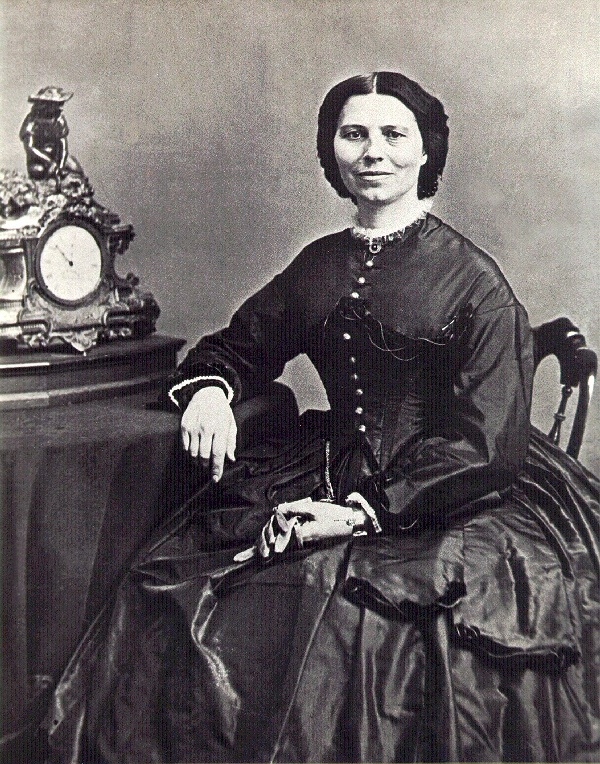
In September we visited the Clara Barton House, in Glen Echo, MD. I have lived nearby most of my life, but this is the first time I visited.
Clara Barton House, Glen Echo, MD

I learned that:
• The house was built for Clara Barton and the Red Cross in the early 1900s and given for FREE by the developers of Glen Echo, who were seeking a celebrity to live at their new development in the hopes of attracting tourists.
• The "Angel of the Battlefield", also known for her services during the Civil War, was actually not a nurse, but a college graduated teacher and Civil Servant to the U.S. Patent Office. (She was the first woman ever to hold a clerkship with the federal government.)
• The Red Cross existed before Clara Barton. After the Civil War, Clara Barton was a speaker and traveled speaking for awhile, but had a breakdown (mental and exhaustion). Her doctor advised a trip to Europe. While there the Franco Prussian War broke out, and again she served as an angel of mercy on the battlefield. While there she learned of the Red Cross organization in Switzerland.
• After the Franco Prussian War, Clara Barton returned to America and founded the American Red Corss, and the first major relief effort of the Red Cross was helping after the Johnstown Flood of 1889.
• One of the first disasters the Red Cross (which Clara Barton founded) responded to was a devastating hurricane's aftermath in Galveston, TX in 1900.


Clara Barton was born Christmas Day, 1821 and died April 12, 1912

***********************************************************************************
Calvert Marine Museum; Drum Point Screw Pile Lighthouse

In October we went to the Calvert Marine Museum on Solomon's Island in southern Maryland.

We had a behind-the-scenes tour. I finally know the differences between a "skate" and a "ray".


We climbed the Drum Point Lighthouse. The "shed" on the outside of the deck was an "automatic flush toilet" (translated -- an outhouse where the refuse went straight into the sea...) in the days of its use.

And, one of the highlights of the field trip was the particularly high tide. The water was coming up onto land through a sewer grate, and the pool of water we found in the yard by the water's edge was teaming with minnows, which was really cool. JD had to get in and try to catch one. He failed, but had fun trying.

Saturday, October 22, 2011

Educating the WholeHearted Child


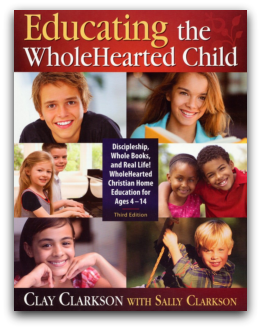
I was so delighted when I learned that I had been selected to review Educating the WholeHearted Child! And when it arrived at my door, I was not disappointed! This is one instance where I wanted to judge a book by its cover! I knew this would be a great book!


So, I received this wonderful book -- it has a wealth of information in it... it is a book that should be pored over, pondered, savored, read at length and re-read... We were given this incredible encyclopedia of home schooling, and we were given about a month to get an opinion of it and tell our friends. ...::sigh:: There is so much to this book I haven't had a chance to check out yet. (It has 376 pages!) I feel like I have gone to a Dutch Smorgasbord, walked in the door, and immediately had to pick and choose what I would sample, because there was no way I could get to everything!

So, what I am saying is that I am giving you my opinion, but so far I have dabbled only in the smallest part of this wonderful book, ...but that will have to do.

Clay and Sally Clarkson are a parents of four adult children whom they home schooled all the way. They are both authors of books to help home schoolers. Clay Clarkson wrote Educating the WholeHearted Child with his wife Sally's assistance, and it was published by Apologia Ministries. Together they are clearly a plethora of information!


So to get started, I opened Educating the WholeHearted Child to the Table of Contents to decide where to start. So much to read; so little time! The main content of the book is broken into four sections, which are further subdivided into chapters. Before these sections there is a sizeable Preface and Introduction, and following these sections there is a Post Script and an extensive section of Resources.

SECTION 1, HOME, looked like information I would save for later. I am not just starting out, and my son is not even at the beginning, so much of the material in Section 1 looked like material I would have wanted to read 20 years ago, or at least 7 years ago, when I was starting out with my son. I will certainly go back and look at it, but didn't have time to read it for this review. But guess what? You can read Chapter 1 if you want to... give it a click!

SECTION 2, LEARNING would have been a great place for me to start, because it explains the entire concept of Clarkson's "WholeHearted Learning" perspective. I did not start there, though, because chapter titles in Section 3 were calling me. So, like Section 1, I will go back and read Section 2 later.


SECTION 3, METHODS was definitely intriguing to me, as the titles were right where I am in my homeschooling. I skipped Chapter 10 -- The Study of the Bible, since between Awanas and regular readings we kinda have our system in place on that one. So I started the book in Chapter 11 -- The Study of the Basics, and dove in head first with a highlighter in hand.


So, I've been reading and reading. But now my review is due, and I still feel I've barely scratched the surface! Even so, this is what I can tell you...

This book is a vast storehouse of information. It is worth every penny of its price. It is a book I will return to again and again. I can't wait, even now, to get back to it and read more.

Things that I have liked loved while reading this book:
• a refreshing of my spirit for the task we have undertaken and for what lies ahead;
• reassurance that I am doing well in certain areas;
• encouragement and ideas on how to do differently in areas where I am not doing so well;
• new ideas to inject breaths of fresh air into our homeschool.

Now, here's what I noticed on the downside... Clay Clarkson writes in a way that can come across sounding as if he knows what is right, and therefore his way is the way you should do things. (He doesn't say this outright, but his writing style leaves me with that feeling.) There are some areas where, even if his methods are the best, not all of us can implement them.

One reason some of his opinions might be written as they are, rubbing me the wrong way, could be because I am acutely aware of the way variations in state homeschooling laws have an affect on the freedom (lack thereof) that some of us have to do things the way he suggests.

What I am referring to, specifically here, is this: the Clarksons live in Colorado. I used to live in Colorado. The homeschooling law in Colorado is wonderful and freeing. You are required to register to state that you are homeschooling (I can't remember, it might be every year that you inform the state...), promise that you will homeschool an average of at least 4 hours a day for 180 school days, and starting in Grade 3 your children will take standardized testing every other year. That's it. That's all they require.

I no longer live in Colorado. I now live in a state where I will be reviewed once or twice a year either by my local county school's representative, or I can pay and be reviewed by an approved private school. Either way, I am required to demonstrate that my child received “[R]egular, thorough instruction" in Mathematics, Science, Social Studies, Language Arts [which then means I have to show teaching in Grammar, Spelling, Handwriting, Vocabulary, Writing (as in compositions)], Art, Music, Physical Education, and Health. Then, because my private oversight is through a Christian school, I need to keep documentation of what we do for Bible training. So, all this documentation needs to be well kept, constantly organized, reduced, and prepared (usually in the form of a portfolio) to present for review once or twice a year. And documenting on my daily lesson planner, for instance, that child gave oral narration of the reading assignment will not cut it for this portfolio (depending on the age of the child and the bent of the particular reviewer) -- I have to have a paper trail. In other words, if there is oral narration, I myself then need to write up the narration so that there is documentation that the child did the work.

So, I am reigning myself in here -- it would be soooooo easy to get off on a tangent and start complaining about the laws in the state where I live, but I will stop now and try to just be thankful that they are better here now than they used to be, and to be thankful that it is legal to homeschool here at all.

Back to the review. So, some of the great ideas and methods that Clay Clarkson was writing were immediately being rewritten in my head to translate into more work, if I were to implement them, due to my need to comply with state laws in a documented way.

And some of his opinions I just disagreed with. One example would be a section he wrote about Spelling. He made certain comments that just irked me in the area of teaching Spelling. And I think all that this really amounts to, as I think about it, is that he has certain ideas about Spelling that he has become convinced of over his years of homeschooling, and I have certain ideas about the subject that I have developed over the years, and we just disagree. For example, he said, in answer to the question, "Should I continue teaching phonics in order to teach spelling?"

“The bigger question, of course, is whether of not your child should be required to learn and master all the phonics rules for their own sake. The purpose of phonics is to teach reading, so if your child is reading well, it’s perfectly alright to put aside the phonics, even if you never made it through all the rules. When your children are writing easily and well at around nine or ten years old, you can review the rules of phonics with them then, but only if they are helpful. Phonics will not magically turn your child into a good speller. If misspelling patterns emerge in your child’s writing that reflect phonics rules, then study those rules with them if that makes sense.” Where this didn't work for me was with a child with a Learning Disability, and in this instance the methods I was using would have worked in conjunction with the LD program that child went through, however she and I had both become discouraged and had given up on it at that point.

This is an example where I just plain disagree. I consider phonics and Spelling to be very seriously entwined, and I teach Spelling through the phonics of the phonograms. I also find that the better the child knows the "phonics rules" (which I consider the Spelling Rules), the better he will be able to read and spell.

Summary: This book is definitely worth it. There is an enormous storehouse of information and inspiration here, that makes reading it clearly worth it, even if you need to take certain sections of it with a grain of salt. As with just about any resource, educational, inspirational, spiritual, or otherwise: take what works for you, and just read past what you don't agree with or which doesn't work for you. The good of this book way out-weighs any objections, and I can't wait to get back into it and read more, more, more. This is a book that can be used either to read slowly, savor, take notes, and ponder, or to pick up, quick, for, "I wonder how or what I should have Janie memorize... This book is a serious support for the Christian parent, in general, and especially for the Christian homeschooling parent. I love this book! From me it gets two thumbs up!

Summary information:
• Product name: Educating the WholeHearted Child.
• Author(s): Clay Clarkson, with Sally Clarkson
• Product price: $22.00
• Available from: Apologia Bookstore
• Publisher: Apologia Educational Ministries
• Additional resources available from publisher: Science curriculum; worldview resources; resources for parents; tools for parents; online Apologia Academy; and inspirational Apologia Live Conferences.

Disclosure: I received a free copy of this book in exchange for my honest opinion. I received no other compensation (other than the book), and this page contains my honest opinions.

This has been a TOS Homeschool Crew Review.
Photobucket


Throw me a bone! Leave me a comment! I love comments!

Sunday, October 16, 2011

Visual Latin

The cornerstone of my curriculum that I use with my son is Ambleside Online. I have used Ambleside for six years now. Before settling with Ambleside Online, I had looked at The Well Trained Mind, Trivium Pursuit, and Classical Education in general. I had even used Tapestry of Grace for eight years straight!

Through my research and application of the various above-mentioned educational program choices, there was one deep, dark, underlying, troubling suggested topic of study... LATIN! Never having been educated in Latin myself, and having purchased Latin programs that I failed at and failed to even fully attempt to implement, I had developed a personal response of a sort of a shrug that I can't teach Latin, which hid a nevertheless present longing to be able to conquer it--not only to educate my son in Latin, but to actually learn and understand it myself as well.

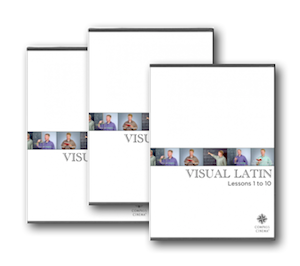
Fast-forward to my current year on the TOS Homeschool Crew. I was offered the opportunity to try out, for the past month or more, a home program called Visual Latin created by Compass Cinema. [I received Visual Latin Lessons 1-10 for free in exchange for this review. I did not receive any other compensation.]


What a blessing this has been to me! There is finally an avenue where modern technology can
help me conquer a dead language!

Visual Latin can be purchased on DVD or can be acquired by digital download using i-Tunes videos. I really wanted to be able to do the program on the television in our classroom, and not have my laptop tied up while watching the lessons. The folks from Visual Latin were so great--they not only send me the DVD, but also sent me the digital downloads! That was so wonderful for me because...

As day passed to day, this poor struggling mama had one trial after another. Initially, when I had the download but the DVD had not yet arrived, I was struggling and struggling not only to figure out how to use i-Tunes videos, but also, once I downloaded the lessons, I struggled to locate where they had saved on my computer. Can we say growing pains (my pain I experienced to grow with this digital technology). So relieved I was when the DVD arrived in the mail, and happily I loaded it into my computer, downloaded the instructions and the pdf worksheets, and then put the DVD into the television's DVD player for our next lesson.

Of course that would have to be a Friday. Do you have any guesses as to what my next trial was? Well, lesson came and went, and DVD got left in the machine. The weekend came, and the "kidlet" used the machine to watch other entertaining movies. Monday came, and an unhappy momma was left walking around in circles saying, "Where did I leave the DVD?" "Why isn't the DVD in its box?" "Where is the DVD?"

So, to minimize lost time, I again was struggling with my computer to find where the lessons saved when I downloaded them. I finally went back to the original email to download them again. I probably did this daily. If their technology counts times downloaded, they're probably wondering at this point why someone who received the DVD has downloaded the lessons 15 times...

DVD one day quietly reappeared, and Momma sighed and put it safely into its box. Only to be unable to locate the box the next day. ::sigh:: Have I mention that I am clutter-challenged?

Anyway, back to my description of the program...

Visual Latin is taught by an attractive, funny young man named Dwane Thomas. I especially like this because a huge disadvantage for my son in our homeschool has been that the only teacher has always been a woman. I like for my son to see this bright, funny young man excited about teaching this subject that my son is still skeptical about applying himself to. I like for my son to have a man teaching him one of his subjects.

Visual Latin is set up in the following way. Initially there is a four part Introduction for you to listen to with your child. (I listened to it first, and then listened to it with my son one part per day for four days.)
This overview will contain part of that information:


Then, Disk 1 contains some pdf files for you to start out with, including Instructions. The instructions will tell you to print out a set of worksheets for your student(s) to give to them with each lesson. For each lesson there is a Part A, Worksheet A, Part B, Worksheet B, Part C, and Worksheet C.

Part A is a section teaching Grammar:


Part B is a section teaching how to build sentences in Latin:


Part C is a section where the children jump in, right from the first lesson, reading Latin!


As we worked on Part C of Lesson 1 my very resistant learner, no joke... turned to me with a half-smile and a look of amazement and said, "I'm reading Latin, Mom!"

The instructions anticipate for most students to cover 2 lessons per week. After doing Lessons Parts A, B, and C (with the worksheets), the student is supposed to review the same movies for a day or two before moving on to the next lesson. Our current year is so busy with co-op and field trips that we have actually been doing one lesson per week. One of the great things about this program is how you can adapt it to your life -- go faster or go slower; it's all good!

I can see the importance of review, but I strongly think this program would be better if it were changed to include a Lesson Part D, that would be a review by itself. This could a faster review, so that it would cover the same material, but cutting out all the time spent introducing the concepts that were introduced in parts A and B, and it might quickly translate the words that were new in Part C of the dictated section. Review is important and essential, but the review provided could be better if it were different than just rewatching the initial material.

I am very happy to have had the opportunity to try out this program, and I might, in a few weeks, decide to purchase the next DVD for the next set of lessons. About this time you may be thinking, "It must be great to be you!", right? Well guess what? Visual Latin knows that Latin would be of value to everyone. They also know, I think, that if you try this you are going to like it and are going to want to continue with it. Guess what again... cause I haven't told you the best part yet... You yourself (yes, you!) can go to their site and download and try out the first six lessons for free, and you don't even have to write a review like mine! They are a new company breaking into a tough market, so they offer the first six lessons for download for free in the hopes that you will be hooked and will want to continue. To get six free lessons, click HERE!

I worked the lesson ahead on the Introduction and Lesson 1, but I found that this program just doesn't need me to do that. I watch the DVDs when my son does, and I try to print the pdf pages out in advance, but sometimes do it when we get to them, and it's all good. This program is working with 7-8 year olds! My son is 11. I am ...much older than that... and it is working for me. So this program is good for almost all ages, from the very young to the... well... older folks like me...

This program tries to hit all the learning styles. You hear the Latin (auditory); you see and read the Latin (visual); and Dwane is funny, which I hopes helps the kinestetic learners... I think this program would be good for anyone. It is wise for everyone to learn Latin, but you probably will need to be motivated to do so, even with this program. Anything worth learning might require work, and work seems not pleasant at the moment...

So did I mention that I myself am actually learning Latin (as well as my son) and am loving it? I am loving learning Latin, and knowing that it is the root language of the Romantic languages, which means that once I have learned Latin it will be easier for me to move into learning Spanish, which will be next on my list. I am loving that Latin teaches Grammar as well, which will make the Language in our English language easier for my son to understand as well.

I love this program. I am not so sure about my son. I read other reviews and other folks' comments, and no, my son does not beg, "Please, Mom, can I do my Latin now?" That being said, I can't be sure whether or not my son actually likes this program. I do know that I want him to learn Latin, and I do know that he is prone to complain about any and all school work I assign to him. When he has complained about Latin, I have taken note and have tried to find out what is actually going on in his mind. I ask him if he would like me to try a different Latin program, and he emphatically makes it clear that if he must study Latin, he wants to stay with Visual Latin.

Not convinced? Well, why not just watch an entire lesson right now to see just exactly how it works.

Visual Latin is available to purchase in many different ways, chunks, formats... as follows:
-- The complete Year 1 of Visual Latin [Introductions A-D, Lessons 1-30, and absolutely everything] is available in DVD format for $80.00 for an individual or family, or for $150 for a group or class.

Or, since you really hadn't saved up for this, you can buy Year 1 in sections. It costs more overall, but you can pay in sections that way. The downloads cost less than the DVDs, but here's the other way to buy it:
--Lessons 1-10 DVD for $30 or download for $25;
--Lessons 11-20 DVD for $30 or download for $25;
--Lessons 21-30 DVD for $30 or download for $25
[So the total cost for downloads can be $75, and the DVDs can be either $80 all at once or $90 purchased in separate purchases.)

Latin II is in the works. The first ten lessons have been completed (available for $25 for the download or $30 for the DVD). By the time you finish Latin I, they will probably have Latin II finished.

In addition to Latin products, Compass Cinema
has produced some additional DVDs and Music materials (Daniel; Parables; "Ask Me WhoOo"), and also has available free downloads of some classic materials that many will appreciate.

To read more reviews of Visual Latin, go to the TOS Crew Blog.


All comments are welcome and desired. I like knowing I didn't put you to sleep...
Tuesday, October 11, 2011

Scruble Cube

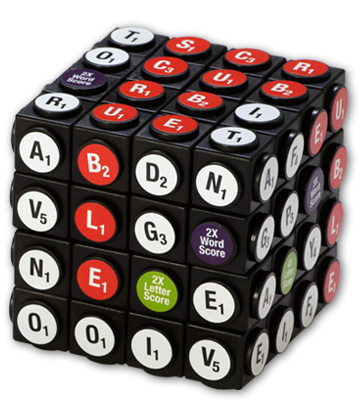
Have you heard about Scruble Cube? It's like a cross between Scrabble and Rubik's Cube.

This a word game in a cube, with parts that move on six planes, making in necessary to focus on many levels to create words.

The creators of Scruble Cube, RSV Productions, cooperating with The Old Schoolhouse Magazine, sent select reviewers the Scruble Cube to use, play with, enjoy (or hate), and review. I was happy to be selected because I was intrigued by this device. (I received a free Scruble Cube to review; I did not receive any other form of compensation for my review. I try to make all my reviews balanced, reporting the good, as well as the bad impressions I have with any product.)

Since Scruble Cube is similar to Rubik's Cube, I need to tell you right now I was never very good at the latter. The said cube, by the way, had only 9 faces on each plane of the cube. Scruble has 16 squares per plain.

The Scruble Cube comes protected in a sizeable package -- one meant more for display than for storage.

I imagine eventually I will find some sort of box that is something like 6"x6"x4" to store this in. The Scruble Cube comes with a sand "egg timer", a pad for keeping score, and hidden in the box is a set of directions (that I was wondering about for ages, and finally found). The directions are very helpful! :)

Now here's something to make you think... The cube comes with a timer. That means at times you will be racing the timer, trying to figure out your word before the sand runs out. The bottom of the package comes with a warning: "NOTICE: The 4x4x4 SCRUBLE Cube has many moving parts and is not intended for high speed manipulation. Please align all rows before moving them and NEVER force pieces into place while twisting and turning. RSV Productions, Inc. cannot be responsible for damage caused by improper use." If the user needs to be careful not to manipulate rapidly, then I suggest they do not package it with a timer!... I know part of the idea is to limit the time when people are taking turns, but I still think it should go...

So there are many ways to play this cube. There are ways to play with up to four people. It is also easy enough to play alone! For this reason, in my opinion this cube makes an excellent gift to... for instance... a public school teacher. A teacher can find hours of mind-challenging fun just playing it her(him)self, but it can also be pulled out to engage the students at times. I think, though, that it takes a certain age of student, or at the very least a certain type of student, to enjoy the cube.

For example, I am a word-game-player, descended from a long line of word-game-players, originating from the long cold snow-covered winters of a family wheat farm out in the middle of no where, in the northern plains of North Dakota. This is an area where, similar to The Long Winter, snows fall to depths of over 6'. All that to say that I play and am good at these traditional word games, and it has conditioned my family to avoid word games since they seldom beat my scores. So, no matter how I have prodded, I have been unable to interest anyone in my home in playing this game.

So, since I was interested in seeing how others would react to it, I took the cube with me when I went to a meeting. I figured that since we usually sat around for a few minutes before they began, I would pull it out and see if I could interest anyone in trying it out. So, I pulled the cube out and offered it to another meeting attendee. He looked at the cube, looked at me, one eyebrow lifted, and he said, "I'm not very good at puzzles." That was it. He wouldn't touch it. ::sigh::

Anyway...
In addition to many ways that Scruble Cube can be played, there are many ways that it can be used as a supplement to your Language Arts program. It can be beneficial to your child's spelling. It can contribute to their critical thinking skills.

RSV Productions has provided all sorts of supplemental links that can be beneficial and helpful for you and your homeschool. Here are some educational ideas:
Math and Language activities, creating words using a dictionary and adding score (3rd-6th grade);
this one looks real fun, like a scavenger hunt - Scrabble Worksheet (3rd-6th);
Scruble make a sentence (3rd-5th);
Scruble Vowel Math (3rd-5th);
Scruble Word Logic (3rd-8th); and
Scruble Periodic Table fun (5th-10th).

Scruble Cube is available from RSV Productions, Inc. for $24.95. RSV Productions also makes another intriguing game called Jishaku, which I'd also like to check out some time!


You can read more reviews of the Scruble Cube on the TOS Crew Blog.

Saturday, October 8, 2011

October - What the Curriculum Choices look like now....

One month in, and my choices have been shifting. I started the school year thinking I was finally transitioning back to Tapestry of Grace. (I used TOG for 8 years with my older students. I loved it, own it, always thought I'd go back to it...) But after embracing Charlotte Mason principles for 5-6 years, I find that thoughts of educating my son using TOG now appear to me... let's see... The analogy that keeps coming to my mind is something like... He's not really thirsty, but I'm insisting he drink, so he grudgingly sits with his mouth open waiting for the drink, and I open up a fire hydrant and deluge him with so much that he cannot take in any of it...

::sigh:: Don't get me wrong-- I still know it is a good curriculum, but I guess I have come to believe it is no longer for me, and it is not for every student, and it is not for my son.

So, anyway, here's what our curriculum choices are looking like right now.

Bible: Awanas and daily Bible reading

Math: Horizon's Math 6

Science: current (week 3 of 8) co-op of Chemistry; will be followed by Apologia Flying Creatures of the 5th Day (with lap-book) (I'm going to get it done this time, dog-gone-it!) Supplemented by Ambleside Online science reading assignments (Madam How and Lady Why and Fabre's Storybook of Science) as well as weekly nature study, using Anna Comstock's Handbook of Nature Study .

Language Arts:
Spelling: All About Spelling
Handwriting: Horizon's Penmanship 3 (all right, he's in 6th, but we never finished this so why buy a 6th grade one -- this one is doing the job) which will be supplemented/substituted at times by copywork related to other assignments
Grammar: I have Easy Grammar 6 and Daily Grams 6, but I am not certain I will actually use them, because I find we are adequately covering Grammar in our Latin studies.
Latin: Starting year with Visual Latin Lessons 1-10 (because I'm reviewing it), then transitioning to First Form Latin (which I am also reviewing), which definitely states you learn the Latin by learning the Grammar first.

History/Geography (Social Studies): Ambleside Online, Year 4 (2 terms) to Year 5 (1 term)

Art: Ambleside Online Artist Study, (but not following their schedule, rather studying artists I choose)

Music: Ambleside Online Composer Study (but not following their schedule, rather studying composers my co-op partner and I choose)

PE: During Spring and Fall co-op, participating in Physical Education activities offered there; other times during the year regularly particupating in physical activities and documenting it.

Health: I hate that my state requires that we actually intentionally (separately) provide instruction in this course and document it, as if it isn't already a part of our lifestyle... That said, I think I have the 6th Grade A Beka Health sitting ready to work through sometime this year.

What I use will continue to be tweaked as TOS Crew gives me different things to use. I am especially hoping to receive the Artistic Pursuits book for my son's grade level!

Thursday, October 6, 2011

Organization Apps

One of my favorite organizational gurus, Carmen Coker, sent out a great email today, with permission to republish, so I'm going to include it here. Hope you are helped by it.

Time to iOrganize My Life

I have to confess, I have a new favorite spot to go shopping. It’s open 24-7, everyone is always friendly and the prices are rock-bottom. Sometimes I even get some pretty great stuff for free! Yes, I’m a big fan of shopping at the app store. This store is an amazingly useful place for those who are looking to make the most of their time. Of the hundreds of thousands of apps (short for software applications that run on mobile devices) available for all every type of smart phone, I have found that there are a select few that make the grade for being truly useful helping users stay focused and organized – although I must warn you that none of these include tossing angry birds at rogue hogs (a little shout-out to those who are addicted to the wildly popular “Angry Birds” app.)

If you use a smart phone, but haven’t yet ventured into the world of apps, you’re not alone. Time spent – or wasted – on smart phones has become a serious problem. And that’s where I am stepping in to help you out! I’ve listed here 5 apps I’d like to share with you that have the potential to help you get your life on track by harnessing the power of technology.

Cozi
Consistently voted best organizing app for families by national parenting groups and publications, Cozi is a free app that helps busy families manage schedules, track shopping and to- do lists, organize household chores, and stay in communication—all in one place. All family members can access Cozi from any computer or mobile device. Cozi helps families to be more productive, so they have more time for the things they really want to do.
Available for iPhone, iPad, Android and BlackBerry; free

iStudiez
An education app great for student, teacher and parent is iStudiez. Available in a free “lite” version as well as a pro version, the award-winning iStudiez app tracks course schedules, lectures and labs, tracks tasks and deadlines, plans and reminds of homework, arranges assignments and provides resources to support both student and teacher.
Currently available for iPhone or iPad; free and pro $2.99 versions

Idea Sketch
For creative types with fertile minds that are always spinning out new ideas, Idea Sketch lets you easily draw a diagram - mind map, concept map or flow chart - and convert it to a text outline, or vice versa. You can use Idea Sketch for brainstorming new ideas, illustrating concepts, making lists and outlines, planning presentations, creating organizational charts and more. With this app, you get the best of both worlds – combining fun and productivity.
Available for iPhone, iPad; free and pro versions

Gtasks
Task-masters, rejoice. Google offers the Gtasks app that simply and efficiently syncs with your Gmail task list – and lets you keep a mobile-only list as well. You also have ability to share your lists or task items easily via Gmail, texting and other options.
Available for iPhone, iPad, Android and BlackBerry; free

Seasons
Foodies around the world are always looking for the next big app. Here is one that has a lot of potential. Seasons keeps you organized and up-to-date as you hit the produce markets for what is fresh and in season in your area, including the U.S., Canada, Australia, United Kingdom and Western and Central Europe. This app allows you to organize your shopping list, while also living greener and eating healthier by knowing what is fresh and in season. It includes photos and descriptions of produce and helps you find nearby farmers’ markets as well.
Available for iPhone and iPad; $1.99

As you can see, there are a wide variety of apps with great potential for streamlining the many different facets of life from home to work to out-on-the-town. These 5 are the most recent ones that stand out during my time spent shopping – I meant “researching studiously” – in the apps store. And be sure to let me know when you discover something amazing in the apps world yourself.

© 2011 Clutterbugs, LLC

Carmen Coker is a professional organizer who helps individuals find the motivation and know-how to get organized and stay organized. To learn how to save money, create more space, and manage your time through organization, claim your "FREE Tip Kit: 10+ Pages of Tips and Tools to Help You Get Organized — Finally!" at www.OrganizeClutterbugs.com

Sunday, October 2, 2011

Big changes coming to The Old Schoolhouse Magazine!

The Old Schoolhouse Magazine is already the homeschool magazine of choice in my home! You may have known that The Old Schoolhouse Magazine is available in a digital format... You'll never believe what's coming in January! Watch and find out:


Can't wait!
3