Tuesday, January 17, 2012

AO Composer Study: Mendelsohn

I am working and working to be caught up and organized, but I feel like a hamster on a running wheel, like I'll never get there. (This analogy really works: when I work less, as in run less quickly, I still manage to keep things going, by God's grace; when I work, work, work, I still don't feel like I'm any farther ahead, because all I can see is that I missed this, I missed that... ::sigh::)

So, my Daily Lesson Planner is in sync with AO with the History reading assignments. I have transitioned my Science plans to dovetail with a friend, and we've started Bob Jones Life Sciences. We are in Lesson 3, and it won't get finished in this school year, but my friend will finish it during the summer, and I might or might not. I'm okay with doing just half of it. We were doing other Science before, so we're not going to come up as "insufficient" at our review. I don't want to sacrifice my summer over it unless something magical happens and my son suddenly starts to love it as we get into more hands-on activities, which we will.

So my focus today is getting Composer Study more up to snuff.


Eh.... I need to go do school. Homeschooling is getting in the way of my planning to homeschool. ;-)

Thursday, January 12, 2012

Let's Talk About Composer Study (Maestro Classics)

My current favorite "base" curriculum (main core curriculum that I add other things to) is Ambleside Online. In my state, home school law requires that we educate regularly and diligently in eight basic subject areas: English, Mathematics, Science, Social Studies, Art, Music, Physical Education and Health.

One of the reasons I like Ambleside Online is that composers are studied throughout the years of the child's education, so that by the time of graduation they have had the opportunity to become familiar with the lives and works of 39 composers.

Downfall: I don't always implement my Ambleside Online curriculum plan well. In other words, my lesson plan might say that I am currently to be covering Mendelssohn, but I might not actually be doing it adequately (if at all). Some weeks are better than others, but I wish I were doing better than I am.

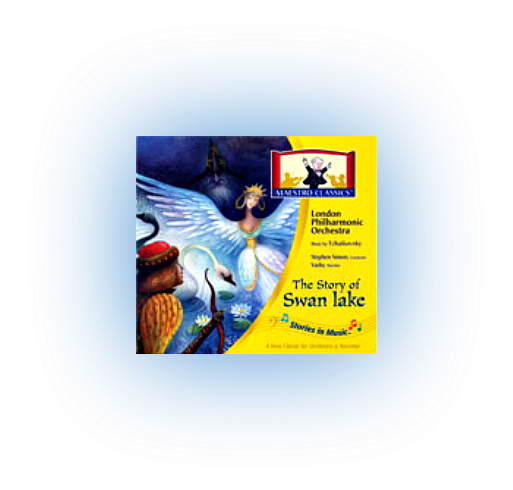
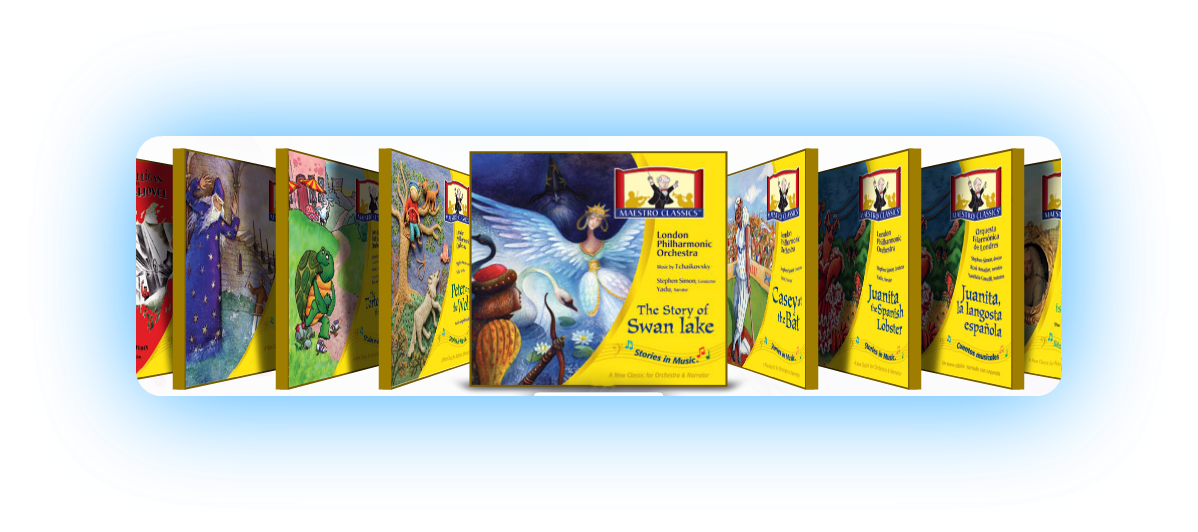
So when the opportunity arose to review a product by Maestro Classics, a CD of Swan Lake, composed by Tchaikovsky, I liked the idea and jumped at the chance. We actually studied Tchaikovsky a couple of years ago, but I really didn't think my son remembered it, nor that we covered it adequately or well. (See previous paragraph.)

So I was delighted when I was selected for this review. Maestro Classics sent me a CD of The Story of Swan Lake, with a little booklet of The Story of Swan Lake. The music on the CD is performed by the London Philharmonic Orchestra. The booklet contains some cute things for the kids: a maze, a dot-to-dot, and a cross-word puzzle. It also it contains some information about Tchaikovsky himself, as well as information about the story of Swan Lake, and the words and music to a little song, "Tchaikovsky Wrote a Great Ballet". There is also information in the booklet about the conductor of the London Philharmonic Orchestra, the CD's Executive Producer and Narrator, the guitarist on the CD, various types of guitars, and a small lesson on major and minor keys. That's a lot of information for such a small booklet!
After perusing the booklet, I put the CD into my drive and began listening. The CD begins with a track that works through the story of Swan Lake, where the narrator explains the plot and the action while Tchaikovsky's music plays in the background. Very nice.

The second track teaches the student about Tchaikovsky, and presents a variety of his musical compositions (in brief).  I really enjoyed learning about Tchaikovsky. I enjoyed the description that he was not a child prodigy, but was rather an insecure, overly sensitive, messy little boy who took music lessons beginning at the age of five. Because he was a smart young man, he was soon reading music as well as his teacher. His father was not preparing him to have a career in music -- he had been told that Pieter would not likely be able to make a career in music, so he was being prepared to have a career as a civil servant. 

Pursuit of music was not being encouraged in his school; however, when his mother died of cholera when he was 14, Tchaikovsky turned to composing as an outlet for his grief. His father permitted him to take piano lessons, but he continued his education to be a civil servant. After graduation, he became a civil servant, but continued to pursue music in the evenings and began to study music theory. Through a few interesting turns of events, Tchaikovsky made the decision to quit his Civil Servant job to attend the newly opened Conservatory of Music in St. Petersburg, Russia. When he graduated, he was invited to serve at the Musical Conservatory at Moscow. There were ups and downs in his development, but his works quickly became popular. He himself still preferred to be behind the scenes, even as other musicians performed the music that he had composed. Interestingly, Tchaikovsky's music was more popular in America than it was in Europe! Tchaikovsky died under mysterious circumstances at the age of 53.

People continue to love Tchaikovsky's music, his melodies, and his ballet.

After a section about Tchaikovsky himself, the CD talks about the music of Swan Lake itself. The conductor narrates explaining that ballet contains two types of music: dance music, and music to tell the story.

The CD's third track is a section of solo on electric guitar. It is wild, blaring, and I didn't like it. The accompanying booklet explains that the music is that of Joe Stump, one of the top shred guitarists in the world. Obviously I don't like shred guitar. I know they didn't have electric guitar in Tchaikovsky's time...

The CD ends with three tracks about the song, "Tchaikovsky Wrote a Great Ballet." - The first plays a piece of music that Tchaikovsky wrote, set to the words of the song, "Tchaikovsky Wrote a Great Ballet". That track is followed by the same song an additional time, music only, no words. The CD ends with the producer encouraging the listener to have fun with the song of "Tchaikovsky Wrote a Great Ballet," following along the words and the music in the booklet.

The Good and the Bad (and recommendations):
First, the good:
  • It's Tchaikovsky. Hey! I love it that materials are being created to teach children to appreciate classical music. I love that the research has been done for me: the music is there, the composer's biography is there; the story behind the music is there. 
Then, the bad:
  • I really love Tchaikovsky. While the CD serves an educational function, I still wish there were more pure music. In fact, I would love it if the CD were two sided. One side could be exactly this CD; the other side could contain as much as possible of the music of Swan Lake. That would have been perfect.
The Specifics:
  •  Maestro Classics materials are intended for anyone ages six and up. My personal opinion is that most families will find these materials most suitable for children ages 6 - 12.
  • I did not detect any particular religious bent in this product.
  • Study of classical music is good for all students. I guess, theoretically, auditory learners might benefit the most from this type of product.
  • I will be recommending this product to my friends who also do composer study and expose their children to classical music. I think Maestro Classics has a lot of room to expand their product offerings. I would love it if they were to go to my particular curriculum's home page, look up the composer studies, and make one CD with six musical pieces each of all 39 composers that the composer study schedule cycles through. They could do all my work for me! They could have the musical works on one side of the CD, and the other side could tell the biography of the composer, a little history and geography of his life, and the stories behind the musical scores that are on the flip side. Well, I'm probably dreaming, but I guarantee that I WOULD find a way to buy three CD's a year for my three composers of the year if they were to do this for me! :)
Disclosure: I received a free  CD of The Story of Swan Lake, by Maestro Classics, in exchange for my honest opinion and review. I received no other compensation (other than the aforementioned), and this page contains my honest opinions.

This has been a TOS Homeschool Crew Review.

Photobucket
TOG Crew Review page for this product.Throw me a bone! Leave me a comment! I love comments!

Tuesday, January 10, 2012

Mr. Smith Goes to Washington

Confession: I love Jimmy Stewart.

Okay, I've been married 32 years, and the dirty secret is out: I'm in love with another man.

Now here's where it gets complicated: My 22 year old daughter and I have a crush on the same man!

No, wait, it gets worse! We're both in love with a man who passed away many years ago!

There. It's out. I have confessed.

Just coming out of the Christmas season, and my full, sweet dose of Jimmy Stewart in It's a Wonderful Life, I roll into more cerebral viewing with Mr. Smith Goes to Washington. Sadly, my current student, a 12 year old boy, does not yet appreciate the wonder of James Stewart, and cannot yet see through the black and white of old movies to fully appreciate their content, but I am working on him.
 The importance of the movie, Mr. Smith Goes to Washington, should not be overlooked in this, an election year. I'll grant you, it is fictionalized, but unlike many movies, fictionalized movies from the 1950s were frequently still largely factual, and created to help you learn and make you think.  To broaden my ability to glean from this movie and to help my son benefit from this movie, I was blessed to receive the  opportunity to have the Zeezok Publishing's Z-Guide to the Movies for Mr. Smith.


I received a PDF download of the Movie Review for Mr. Smith Goes to Washington, for the High School Level. First I'd like to say if you have never seen this movie yourself, please view it! It is an education on many levels -- government in the early-mid-1900s; honesty vs. corruption in government; types of pressure placed upon government representatives, to name a few. There are so many levels on which I can still learn from this movie that I look forward to going through this review again very soon for my own edification!


About Mr. Smith Goes to Washington (High School) Z-Guide:
  • beautiful, and very professionally made;
  • PDF download;
  • 36-page document;
  • available for levels elementary, middle-school, and high school;
  • Z-Guide price, $12.99; DVD price: $15.98;
  • material presented in a religiously-neutral format (not offensive to anyone).
From the guide: "Designed for the high school student, this guide contains a topic, overview, movie synopsis, and ten learning activities based on the film."

I like the way the guide lays out, day by day, recommendations for using the guide. It tells you step-by-step, "Do this, do that, have student do this, follow up this way," all as suggestions which you can either follow closely or can divert from as suits your situation. 

I like the way, at the very beginning, it advises the teacher to read through the entire guide before even watching to movie. I often try to short-cut, and don't actually ever get to the step of reading through the instructions, which can be so very helpful and important.  The use of this guide, however, proved to me how inadequate my own education of our government has been.

I was embarrassed, annoyed to find vocabulary in the guide that was over my head. The guide contained the word "bicameral", which I was unfamiliar with, but which was not explained in the guide. (Bicameral means, "having two branches, chambers, or houses, as a legislative body", but I didn't like having to stop reading to go look it up when the definition could, so easily, have been inserted into the guide where the word was used.) I don't mind learning new vocabulary, but when I'm using a guide that is supposed to prepare me to teach, I don't want to have to go researching as well on my own. The wording used with the word "bicameral" could be changed slightly just to clarify that paragraph for the teacher.

Explanation was given regarding how Senators were chosen before the Seventeenth Amendment vs. how they are chosen after the Seventeen Amendment, which left me wondering, "But what did the Seventeenth Amendment say?" Maybe, reading the amendment, it would be obvious to me that the amendment's content is explained in the paragraph, but it doesn't say so, and I don't want to stop what I am doing to go look it up and check...

These two objectionable items I found were in the notes to the teacher. I did not find any other areas in the guide where there were any similar issues.

I did like the excellent explanation of filibuster given in the guide. I know it would make it longer, but explanations like that are what I wanted for other bits here and there as well.

I consider the "Movie Synopsis" contained in the guide to be excellent. It gives a clear picture that enables me to understand certain aspects of the movie better, even though I've already seen it before.

The ten possible activities offered for the students for their enrichment were excellent. One activity had questions the student was to try to find answers to while watching the movie. Another activity was a crossword puzzle, which looked fun. There were questions that could be answered in essay format, or brief format, whichever you prefer. There were creative-thinking activities, such as create a set of questions a reporter might prepare for an interview with Senator Smith. The student could even create a mock interview and record it for posterity. That is a fun activity similar to activities I have done with my past students, that I remember fondly (even though we did not get them recorded at the time).

One activity asks the student to consider and write about foreshadowing found in the movie. This is an excellent activity to require, and is an example of material that high school students need to become familiar with. This activity goes through many literary techniques, requiring the student to understand the techniques and give examples of them found in the film.

There is a complete answer key to each activity at the back of the Z-Guide. I was glad, because even I had difficulty finding some of the answers, but that's okay because even correcting your wrong answers helps you to learn.

It helped that I really love this movie, but I really loved this movie guide. I have long felt that I was inadequate to help my children glean as much as they should/could from great classic movies such as this one. I would highly recommend this guide (or the age appropriate version for their family) to anyone.

Negatives:
There were very few negatives to be found, and what I list may cause you to say, "Duh!", but here they are:
  • It is a PDF download, which means you need to print it out. I ran out of ink.
  • You need to have a copy of the movie. I don't own it. My movie internet download didn't offer it. My library only let me borrow it for seven days. This was annoying. I hope to buy the movie soon.
I cannot tell you what my student's reaction to the material is/was because:
  • My son is Middle School, and I was reviewing the High School level, and he's not ready for it yet;
  • My library required the return of the DVD before I got a chance to watch it with him. (I had it during Christmas week; it was a 7-Day borrow.)
  • I immediately requested a copy to borrow again, but it has not yet come available for us to use;
  • As I stated, my printer ran out of ink, So I don't have the Z-Guide printed out, and we're not going to get it done while we don't have a hard copy of it.
So, that's it. I hope you enjoyed my review.

In addition to the Z-Guide for Mr. Smith Goes to Washington, Zeezok also carries Z-Guides for a wide variety of movies at the various grade levels. Here are some of the movies that I like that there are Z-Guides for:
The Great Escape (High School);
My Side of the Mountain (Middle School);
Johnny Tremaine; and many more.

In addition, Zeezok carries the corresponding movie DVDs if you wish to purchase them.  Zeezok also carries a large line of Composer biographies and music CDs. They also carry materials for the study of History and Government, Reading and Literature, as well as e-books, audiobooks and Penmanship. Zeezok guides cannot be sold or shared, but you can use them again and again as you work your way through your different children as they reach the appropriate age for each movie or or guide.


Disclosure: I received a free  Zeezok Publishing Z-Guide of Mr. Smith Goes to Washington (High School)  in exchange for my honest opinion and review. I received no other compensation (other than the aforementioned), and this page contains my honest opinions.

This has been a TOS Homeschool Crew Review.

Photobucket

To see other reviews of this, and other Zeezok Movie Reviews, please visit the
TOG Crew Review page for this product.Throw me a bone! Leave me a comment! I love comments!
3